How to Sell Coins Online in the UK
A practical guide to selling coins online in the UK: identification and honest grading, the Treasure Act and reporting finds, the law on counterfeits and tainted cultural objects, pricing, photos, Special Delivery for valuables, and how Capital Gains Tax treats legal tender and other coins.
To sell coins online in the UK, identify each coin by country, denomination, date and mint mark, grade it honestly, and post it using a service that covers valuables. If any of your coins came out of the ground, check first whether they could be treasure, because treasure has to be reported within 14 days and cannot just be sold. Gold sovereigns and other UK legal tender coins are generally outside Capital Gains Tax; most other coins are personal possessions with their own rules.
Identify each coin
Coins that look the same can differ in value because of the date, the mint or a small variety. A buyer needs the details that separate them:
- country and denomination
- date, and the monarch or issuing authority
- mint mark, if the coin has one
- metal, and the fineness if it is a precious metal coin
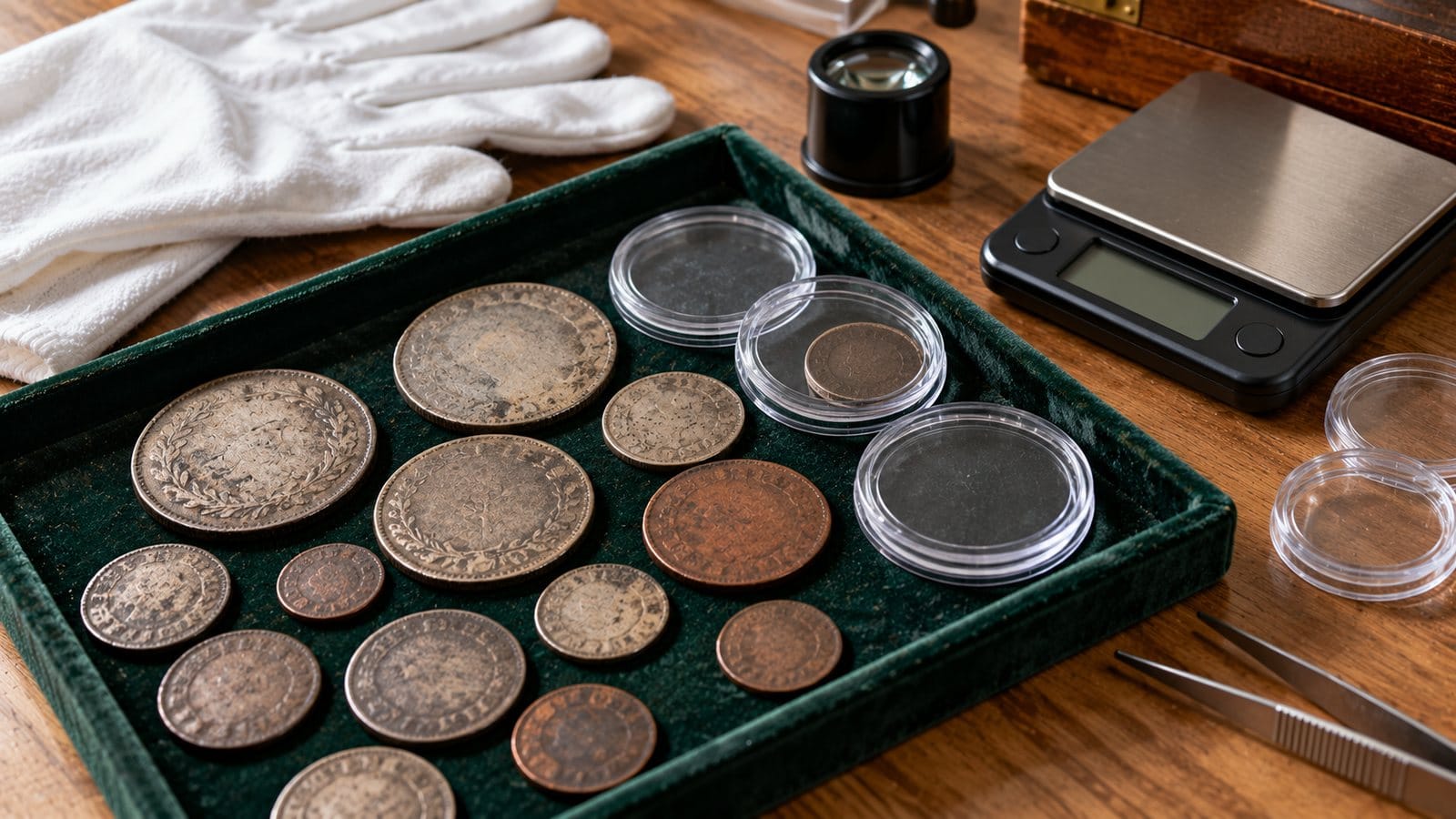
- weight in grams and diameter in millimetres, measured yourself
- any known variety or error, described exactly
- a standard catalogue reference, if you know it
For example, a hypothetical listing title: "1887 Victoria Jubilee head half crown, silver, 14.1 g, Very Fine, light toning". A title such as "old silver coin, rare" tells a collector nothing and claims something you may not be able to back up.
If you sell as a trader, the coin must match your description (Consumer Rights Act 2015, section 11), and a description that is accurate but presented in a misleading way can still be a misleading action (Digital Markets, Competition and Consumers Act 2024, section 226).
Grade honestly, and say if it has been cleaned
UK collectors use grading words such as Fair, Fine, Very Fine, Extremely Fine and Uncirculated. They are a shared shorthand, not a legal standard, so back the word up with what you see:
- wear on the highest points of the design
- scratches, edge knocks and rim damage
- whether the coin has been cleaned, polished or dipped
- toning, spots or corrosion
- holes, mount marks or signs it was used as jewellery
Buyers expect to be told if a coin has been cleaned, so say so. If a coin has been graded and sealed by a grading company, give the company, the grade and the certificate number, and photograph the label.
Coins found with a metal detector
If you or someone you know found the coins, check the law on treasure before you list anything.
Under the Treasure Act 1996, coins count as treasure in some cases even when each one is worth little on its own. A coin is treasure if it is at least 300 years old when found and is one of at least two coins in the same find with at least 10% precious metal by weight, or one of at least ten coins of that age in the same find (Treasure Act 1996, section 1). Objects found with treasure can become treasure too.
You must report treasure to your local Finds Liaison Officer within 14 days of finding it, or within 14 days of realising it might be treasure. The penalty for not reporting is an unlimited fine or up to three months in prison, and Scotland and Northern Ireland have different rules (GOV.UK: report treasure). Finds that are not treasure but are of historical interest can be recorded with the Portable Antiquities Scheme in England or its Welsh equivalent.
Two more points matter if you sell old finds. Keep a record of where and when each coin was found and the landowner's permission. It is also an offence to deal dishonestly in a cultural object, which includes an object of archaeological interest, knowing or believing that it was removed or excavated unlawfully (Dealing in Cultural Objects (Offences) Act 2003, sections 1 and 2). If you cannot show where an ancient coin came from, think carefully before you sell it.
Copies, replicas and fakes
It is an offence to deliver to another person, without lawful authority or excuse, anything you know or believe to be a counterfeit of a currency note or of a protected coin, meaning a coin customarily used as money in any country (Forgery and Counterfeiting Act 1981, sections 15 and 27). Do not sell copies of current coins.
Copies of old coins are sold as souvenirs and teaching pieces, but describe them as copies in the title, and never let a copy pass as an original. If you are not sure a coin is genuine, check its weight and diameter against a reference, compare it with a coin you know is genuine, or ask a specialist. If doubt remains, do not describe it as genuine.
Pricing
Check completed sales of the same coin, date and grade, not current asking prices. For gold and silver bullion coins, the metal value sets a floor, and what collectors pay above it varies with date and condition. For a coin that sells mostly to collectors, condition decides much more than weight: a Very Fine coin and an Extremely Fine coin of the same date can sell for very different amounts, so compare grade with grade.
Photographs
Take each coin out of its holder if you can do so safely, and use light from one side so the detail shows. Photograph:
- both faces, straight on and filling the frame
- the edge, especially for milled or lettered edges
- any damage, close up
- the coin on digital scales showing its weight, for higher-value coins
- the label and certificate, for graded coins
Do not edit the colour; toning is part of the coin's condition.
Packing and posting
Put each coin in an inert holder or capsule, then into a small rigid box with padding so nothing moves, and do not describe the contents on the outside of the parcel.
Choose the service by value. Every Royal Mail Signed For 1st Class item is covered up to £20, and compensation for valuables such as money and jewellery is not available on that service; Royal Mail directs senders of valuable items to Special Delivery Guaranteed (Royal Mail: Signed For 1st Class). Special Delivery Guaranteed by 1pm includes compensation cover up to £750, with additional cover available up to £2,500 (Royal Mail: Special Delivery Guaranteed by 1pm).
If you sell as a trader, you are liable for loss or damage in transit even when the courier is at fault (Business Companion: selling goods via online platforms).
Tax: legal tender coins and other coins
HMRC treats coins differently depending on whether they are currency. Coins that are sterling currency are not chargeable assets for Capital Gains Tax, and only coins that are legal tender count as currency (HMRC Capital Gains Manual, CG76881). The Royal Mint states that its Sovereign, Britannia, Lunar and Queen's Beasts bullion coins are exempt from UK Capital Gains Tax for UK residents because they are legal tender (The Royal Mint: tax on bullion coins).
Coins that are not legal tender may qualify for the exemption for personal possessions, where the limit is £6,000 per item or per set. HMRC says a collection of coins is unlikely to be a set, unless it contains every value issued in one year or during one reign (HMRC Capital Gains Manual, CG76881).
Separately, if you buy coins to sell at a profit, HMRC is likely to treat you as trading, and trading income above the £1,000 trading allowance in a tax year must be reported (HMRC: income from online platforms).
Another way to be found
Exact identification and honest grading give a collector what they need to buy from a photo. You can also list your coins on MC999, a UK marketplace where shoppers discover products and the independent shops behind them. Dealers with a Shopify, Shopline or BigCommerce shop can connect it, and others can add products manually. The How to Sell guide explains both routes.
Already selling through your own shop? See how to add your products to MC999 and give shoppers another way to find your business.
Frequently Asked Questions
Do I need to report a single old coin I found on its own?
A single coin is not treasure under the coin rules, which require at least two precious metal coins, or ten coins, from the same find. It can still be treasure if it is part of a find with other objects, so report it if anything else was found with it. Recording a single coin with the Portable Antiquities Scheme is voluntary and helps build the historical record.
Can I sell coins I inherited without paying tax?
UK legal tender coins are outside Capital Gains Tax. Other coins are personal possessions, and Capital Gains Tax applies only above the £6,000 limit per coin or per set. Selling inherited coins now and then is unlikely to be trading, so Income Tax does not usually apply.
Can I post coins in an ordinary envelope?
You can, but it gives the coin little protection and, on Royal Mail, no compensation for valuables on Signed For services. A rigid box and Special Delivery for anything of value protect both you and the buyer.
Sell on MC999
Ready to start selling without paying commission on every sale? Join MC999 as a Founding Seller and keep full control over your prices, delivery and returns.