How to Sell Part-Worn Tyres and Alloy Wheels Online in the UK
The legal checks a part-worn tyre must pass before you list it, how to quote tread and the date code, the wheel figures buyers need for fitment, a grading scale for kerbed and refurbished alloys, and the courier size limits that rule out most tyres for standard post.
To sell part-worn tyres and alloy wheels online in the UK, inspect every tyre against the part-worn rules before you list it, then describe it by size, load index, speed rating, date code and the lowest tread depth you measured. List each wheel by diameter, width, PCD, offset, centre bore and fixing type, grade its condition on a fixed scale, and check the packed size and weight against the courier's limits before you agree a delivery price. If you sell in the course of a business, a tyre that fails the rules cannot be offered at all, even with a warning in the listing.
Check that each tyre can legally be offered
The Motor Vehicle Tyres (Safety) Regulations 1994, regulation 7 sets the conditions a part-worn tyre must meet before it is supplied. "Supply" includes offering, exposing or possessing a tyre for supply (regulation 2(6)), so a live listing counts. Our guide to selling used car parts online gives the short version; for tyres, run the full check on each one:
- Cuts: no cut deep enough to reach the ply or cord that is longer than 25 mm or 10% of the section width, whichever is greater.
- Structure: no lump, bulge or tear caused by separation or partial failure of the structure, inside or outside.
- Ply and cord: none exposed, inside or outside.
- Penetration damage: none left unrepaired. Repairs must meet BS AU 159; Business Companion, the Trading Standards guidance site, advises using its latest version.
- Tread: the base of every original groove must be clearly visible, and the original grooves must be at least 2 mm deep across the full breadth of the tread and around the whole circumference.
- Moulded marks: a tyre that is not a retread must carry an approval mark (such as an E-mark) plus its speed category and load index, all moulded in when it was made. Retreads need the retread marks listed in the regulation and the Business Companion guide.
- PART-WORN marking: the words PART-WORN in capitals at least 4 mm high, permanent and legible, next to each approval mark. Hot branding and cutting into the tyre are not allowed.
Regulation 7(3) adds that none of those defects may show when the tyre is inflated to its maximum design pressure. Business Companion recommends inspecting before fitting and again after inflating, and warns that loose tyres need especially careful checks: a defect that only appears under pressure is still an offence. If you sell tyres loose, mount and inflate each one for the check.
Who the rules cover
The Regulations are made under section 11 of the Consumer Protection Act 1987, and section 46(5) confines "supply" to supply in the course of a business, adding that it does not matter whether the business deals in those goods. A garage, mobile fitter or breaker selling tyres taken off cars is covered, even if tyres are not its main trade. Tyres on a complete vehicle you sell are exempt (regulation 10), but a set of wheels with tyres fitted is not a vehicle. Breaking the rules is an offence under section 12, with up to six months' imprisonment, a fine up to level 5 on the standard scale, or both.
Measure tread: 2 mm to sell, 1.6 mm to drive
The selling threshold sits above the driving limit. Under regulation 27 of the Road Vehicles (Construction and Use) Regulations 1986, a car tyre needs at least 1.6 mm across the central three-quarters of the tread and around the whole circumference, and the MOT inspection manual, section 5.2.3 applies the same figure. The part-worn rule asks for 2 mm across the full breadth, so a tyre that passes an MOT may still be unsellable.
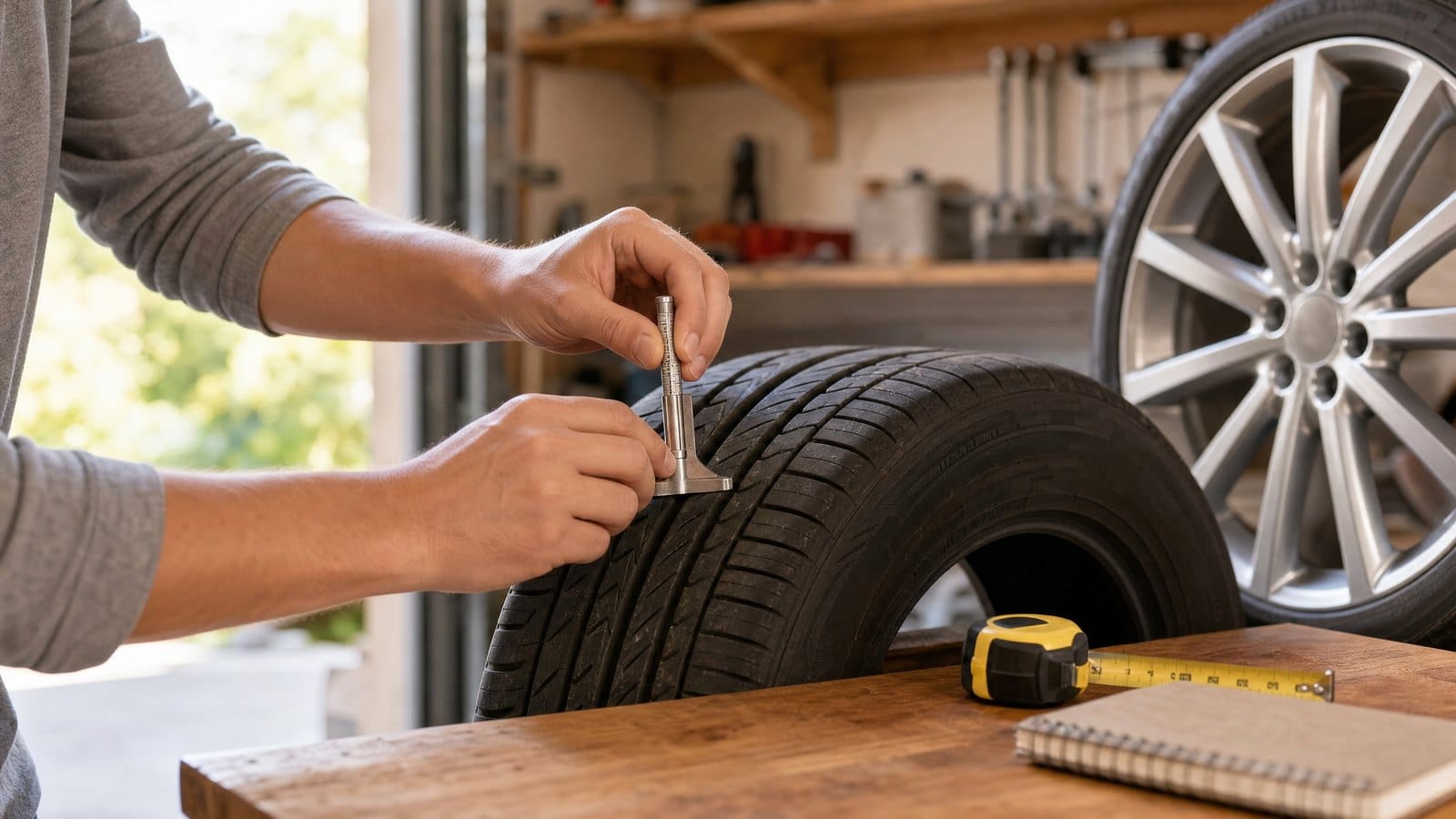
Use a depth gauge, not the wear indicators. Measure the inner, centre and outer grooves at four points around the tyre and quote the lowest reading. Then give the buyer the useful figure: a tyre with a lowest reading of 4.5 mm has 2.9 mm left before the 1.6 mm legal limit. If wear is uneven across the breadth, say which edge carries the low reading, so the buyer can judge it before fitting.
Read and quote the date code
The sidewall carries a four-digit production code: the first two digits are the week and the last two are the year, so 2120 means week 21 of 2020. GOV.UK guidance explains this format and says a retread's age runs from the retreading date. A three-digit code means the tyre was made before 2000, and the MOT manual treats such a code as showing the tyre is over 10 years old.
The 10-year ban covers the front steered axles of heavy goods vehicles, buses and coaches, and single-wheel axles on minibuses; neither that guidance nor regulation 7 sets an age limit for car tyres. So do not promise a tyre is "safe for X years". State the code exactly, photograph it, and let the buyer decide.
Write the size line buyers search for
Buyers filter by the size string, so put it in the title in the same format as the sidewall. Using Goodyear's example of 205/55 R16 91V:
- 205: section width in millimetres.
- 55: aspect ratio, the sidewall height as a percentage of width.
- R: radial construction.
- 16: rim diameter in inches.
- 91: load index, here a maximum of 615 kg per tyre.
- V: speed rating, here 240 km/h.
A useful title reads: "Michelin Primacy 4 205/55 R16 91V, pair, 5.1 mm and 4.8 mm, DOT 3121". Add any run-flat, XL or car-maker approval marking from the sidewall, and for a pair or set give tread and date code per tyre, not an average.
List the wheel specification in full
A buyer needs every fitment figure to know whether a wheel will go on their car. Most are cast or stamped on the back of the spokes or inside the barrel. List:
- Diameter and width: in inches, for example 17 x 7.5.
- PCD: the number of studs or bolts and the diameter of the circle they sit on, for example 5x112.
- Offset: the ET figure in millimetres, for example ET45.
- Centre bore: in millimetres, and whether spigot rings come with the wheels.
- Fixings: bolts or nuts, the thread, and the seat shape (conical, ball or flat). Say whether fixings and the locking key are included.
- Part number and origin: original equipment part number or the aftermarket brand and model, plus the car it came off.
- TPMS sensors: fitted or not, and the sensor part number. The MOT manual lists a malfunctioning tyre pressure monitoring system as a major defect on passenger cars first used on or after 1 January 2012, so buyers of later cars will ask.
Grade alloys on a fixed scale
Define your grades in the listing so "good" always means the same thing:
- Grade A: no kerb marks; light marks only on the barrel, out of sight when fitted.
- Grade B: light kerb scuffs on the rim edge, no metal removed; give a count and location.
- Grade C: heavy kerbing with gouges, corrosion under the lacquer or peeling paint; suited to refurbishment.
- Refurbished: state the method (powder coat, paint or diamond cut), who did it, the date, and whether the wheel was checked for straightness first.
Structural damage sits outside the cosmetic scale. The MOT manual treats any fracture or welding defect on a wheel as dangerous and a badly distorted wheel as a major defect, so describe a cracked, welded or buckled wheel as exactly that.
Photograph what buyers check
- The face of each wheel, square on, in daylight.
- Every kerb mark at close range, with a coin or ruler for scale.
- The back of a wheel showing the stamped size, offset and part number.
- Close-ups of the size line, load and speed marks, the E-mark with PART-WORN beside it, and the date code.
- The depth gauge sitting in the lowest groove, with the reading visible.
- The inner sidewall and any repair.
Pack and post to the carrier's limits
Do the arithmetic first. A 205/55 R16 tyre is about 63 cm across (16 inches of rim plus two sidewalls at 55% of 205 mm). Royal Mail's largest standard UK parcel size is a Medium parcel of up to 20 kg and 61 x 46 x 46 cm (Royal Mail UK services), so most car tyres and complete wheels will not fit. Parcelforce express48, sold through the Post Office, takes up to 30 kg, 1.5 m in length and 3 m length and girth combined; express48large allows 2.5 m and 4 m, still at 30 kg. Compensation up to £150 is included, with extra cover available up to £2,500. A tyre boxed at 65 x 65 x 22 cm measures 65 cm long plus 174 cm round the thickest point, 239 cm in total, inside the express48 limit. Weigh every packed item before booking, because the 30 kg limit applies to each parcel.
Box each wheel separately: cardboard discs over the face, the rim edge wrapped, the valve or TPMS sensor protected, and bolts bagged and taped inside. Check how the chosen service wants loose tyres packed before you book. For a full set, collection is often simpler, and the guide to avoiding scams and fake buyers covers safe handovers and payment.
Price from tread, age and fitment
- Find sold listings for the same size and tyre model, or the same wheel part number, and compare like with like: tread above 1.6 mm, a similar date code, pair or set.
- Keep matching tyres together and list them as a pair or set, stating that model and date code match; split them only after the set has had a fair run.
- For wheels, list anything missing from the set: centre caps, fixings, locking key or TPMS sensors.
- Set the delivery charge from the weighed and measured parcel, not a flat guess.
If you have spare centre caps, locking bolts or wheel covers to list separately, our guide to selling car accessories online covers how to describe them.
Another way to be found
MC999 is a UK online marketplace with a Tyres and wheels category in its Shop Hub. There is no commission on sales; sellers pay a monthly fee based on the scale of their business. If you run a store on Shopify, BigCommerce or Shopline, you can connect it, and buyers complete the purchase on your own website; without a web shop, you can list items manually and arrange payment with the buyer directly. The first 300 approved UK Founding Sellers get the monthly fee free for 6 months.
FAQ
Can I sell a part-worn tyre that has a puncture repair?
Yes, if the repair was done properly and meets BS AU 159, and the tyre passes every other check in regulation 7. Unrepaired penetration damage rules it out. Say in the listing where the repair is and photograph it from inside.
Do the part-worn rules apply if I sell alloy wheels with tyres fitted?
Yes. The regulation 10 exemption covers only tyres on a complete vehicle that is being supplied, plus its spare. Wheels sold with tyres on them are a supply of those tyres, so each one needs the PART-WORN marking and must pass the checks.
Is there a maximum age for a part-worn car tyre?
Regulation 7 sets no age limit, and the 10-year rule on GOV.UK applies to heavy goods vehicles, buses, coaches and minibuses. That is why the date code belongs in the listing. Give the exact code and let the buyer judge.
Can I list tyres under 2 mm as "for scrap" or "off-road only"?
Not as a business. The exempt tyres and circumstances in regulation 8, such as tyres marked at manufacture for off-road or competition use, only lift the marking requirements under regulation 10; the tread and damage conditions still apply. Worn-out tyres should go to a tyre recycler instead.
Sources (checked 2 November 2026)
- Motor Vehicle Tyres (Safety) Regulations 1994, regulation 7
- Motor Vehicle Tyres (Safety) Regulations 1994, regulation 2
- Motor Vehicle Tyres (Safety) Regulations 1994, regulation 8
- Motor Vehicle Tyres (Safety) Regulations 1994, regulation 10
- Consumer Protection Act 1987, section 12
- Consumer Protection Act 1987, section 46
- Road Vehicles (Construction and Use) Regulations 1986, regulation 27
- Business Companion: Part-worn tyres
- GOV.UK: Tyre age restrictions for goods vehicles, buses, coaches and minibuses
- GOV.UK: MOT inspection manual, section 5
- Goodyear: How to read your tyre sidewall markings
- Royal Mail: UK services
- Post Office: Parcelforce Worldwide express48 services