How to Sell Handmade Home Decor Online in the UK
A practical guide for UK makers: safety and CLP labels for candles, lead and cadmium rules for mugs and bowls, fire safety for cushions, fibre labels, honest descriptions and photos, made-to-order items, and Royal Mail's rules for reed diffusers.
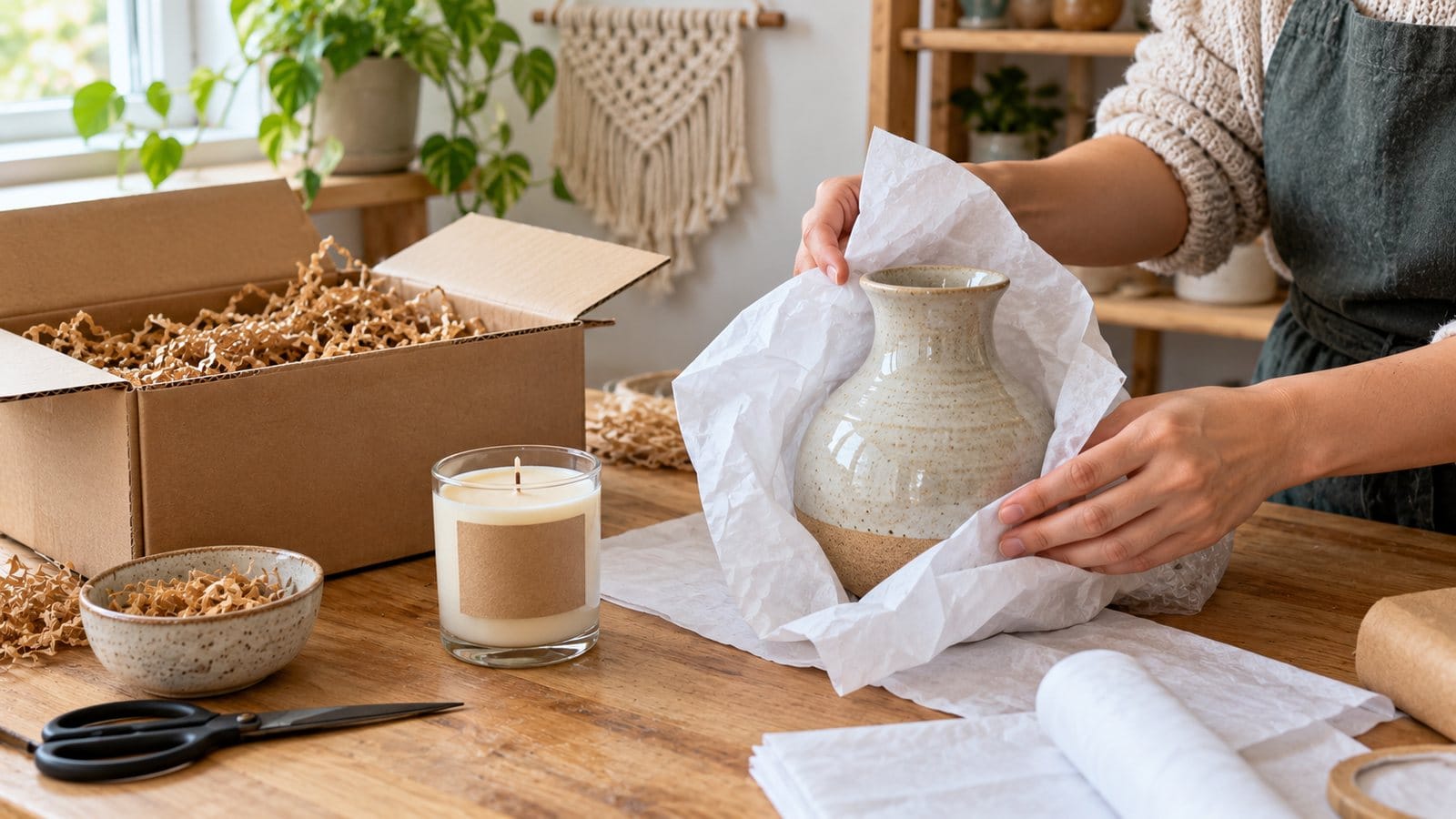
To sell handmade home decor online in the UK, start with the rules for what you make: scented candles and wax melts often need chemical hazard warnings as well as safety labels; mugs and bowls must meet limits for lead and cadmium; cushions must meet fire safety rules; and fabric items need fibre labels. Then describe each piece accurately, photograph it true to colour and size, and pack it for breakage. If you make items to sell, the law usually treats you as a business, so consumer law applies too. The rules below are those for Great Britain.
You are the producer
Business Companion, the Trading Standards guidance site, says that a person repeatedly producing goods for sale to consumers acts in the course of trade, and HMRC says you are probably trading if you sell goods you have made, including items you make as a hobby (Business Companion: candles, diffusers, oil heaters, etc.; HMRC: income from online platforms).
Under the General Product Safety Regulations 2005, the maker of a consumer product is its producer. Your products must be safe, and you must make them traceable by showing on the product or its packaging (Business Companion: general product safety for producers):
- your name and an address in Great Britain
- a product reference, or the batch the item belongs to
Business Companion notes that some producers base the batch number on the date of production. That works for a small maker as long as your records link each code to the materials you used.
Candles, wax melts and diffusers
Candles release substances as they burn, so they carry more rules than most decor. Business Companion sets out what a producer should check.
Safety. Assess sooting, flame size, stability and anything embedded in or decorating the candle that could catch light. Three designated standards cover this: BS EN 15426 (sooting), BS EN 15493 (fire safety) and BS EN 15494 (product safety labels). A candle that meets them is presumed safe for the risks they cover, and Business Companion says candles must be labelled in line with BS EN 15494.
Chemical hazard labels. Fragrance is usually what triggers a GB CLP label, because many fragrance ingredients are skin sensitisers. Ask your suppliers for a safety data sheet for every fragrance oil and colourant. As a general guide from Business Companion:
- a sensitiser at 0.1% or more of the finished candle means adding a statement such as "Contains [name of substance]. May produce an allergic reaction"
- above about 1%, the whole candle is classified, and the label needs a pictogram, the hazard statement "May cause an allergic skin reaction" and precautionary statements
- unscented candles made from bulk wax often need no CLP label at all
Some substances have lower limits, so work from your own formulation, not from these general figures. Buying a premixed fragrance can make this easier, because the supplier may give you the CLP data for it.
Shapes and claims. Candles and wax melts that children could mistake for food, such as cupcakes, fruit or sweets, can fall under the Food Imitations (Safety) Regulations 1989, which prohibit such products (Business Companion: candles, diffusers, oil heaters, etc.). Do not call a citronella candle an insect repellent unless it is a registered product: Business Companion says insect repellents must be registered with the HSE.
Keep a record of each formulation, its batch codes and any test results. Business Companion notes that a producer who carries out no safety assessment or testing will not have shown due diligence.
Mugs, bowls and plates
Anything that can reasonably be expected to come into contact with food or drink counts as a food contact material (Business Companion: food contact materials). In England, handmade ceramics that fall into that group must meet limits on the lead and cadmium that can transfer into food. Unless you can show your clay and glazes contained no lead or cadmium, the limits have to be checked by a laboratory test. At each stage up to and including the retail sale, the pieces must come with a written declaration of compliance, and the maker must make the test results available to the authorities on request (Materials and Articles in Contact with Food (England) Regulations 2012, regulations 10 and 10A).
In practice, ask your glaze supplier what evidence they can give you, test each glaze you use on functional ware, and keep the reports. If you make in Wales, Scotland or Northern Ireland, check the equivalent rules where you are.
Cushions and throws
Cushions are covered by the Furniture and Furnishings (Fire) (Safety) Regulations 1988, but not all in the same way. Business Companion lists scatter cushions and seat pads as covered for their filling material only, while floor cushions and bean bags count as upholstered seating and must meet the full requirements, including the permanent label headed "CARELESSNESS CAUSES FIRE" (Business Companion: new upholstered furniture). Buy fillings from suppliers who can show they meet the Regulations, and keep that evidence with your batch records.
Cushion covers, throws, table runners and similar items are textile products. They need a durable, securely attached label giving the fibre composition, using the approved fibre names, and the composition must be visible to buyers before they purchase online (Textile Products (Labelling and Fibre Composition) Regulations 2012; assimilated Regulation (EU) No 1007/2011, Articles 14 and 16).
Describe it so the buyer knows what arrives
Handmade pieces vary, and buyers accept that if you tell them. In each listing, give:
- height, width and depth, and the weight for anything that hangs on a wall
- capacity in ml for mugs, jugs and vases
- materials and finish, and whether a vase is watertight
- care instructions you have tested, for example whether a mug has been through a dishwasher
- for wall pieces, the fixing on the back and what the buyer will need to hang it
- how much the colour, glaze or pattern can vary from the photo
Be exact with claims. Business Companion warns that "organic" on a candle is controlled even though there is no organic standard for candles, and that beeswax is not considered vegan friendly. A misleading claim, even one built from true facts, can be a misleading action (Digital Markets, Competition and Consumers Act 2024, section 226).
Photograph the real piece
Use daylight and a plain background for the main photo, so the colour is true. Add one photo with a hand or a ruler for scale, a close-up of the glaze or weave, and the back or base. A styled room photo helps buyers picture the piece, but it should show the item you are selling at its real size.
Made-to-order and personalised pieces
Goods made to the buyer's specifications or clearly personalised, such as a cushion embroidered with a family name, are an exception to the 14-day right to cancel (Consumer Contracts Regulations 2013, regulation 28). Tell buyers before they order that these items cannot be cancelled. Items you make in advance and sell from stock can be cancelled in the usual way if you sell as a trader.
Packing and posting
Wrap each ceramic piece separately and pack it so it cannot touch the sides of the box; for valuable or fragile work, a box inside a box gives extra protection. Pack glass candle jars upright with the lids taped.
Check reed diffusers and room fragrances before you post them. Royal Mail's restrictions for UK post say (Royal Mail prohibited and restricted items: perfumes and aftershaves):
- no more than 150 ml per item, and no more than four items in one parcel
- each item in its original retail packaging, inside strong, cushioned outer packaging
- an ID8000 label, with the sender's name and return address on the outside
- posted only at a Post Office counter or a Royal Mail Shop
If you sell as a trader, you are also responsible for loss or damage in transit, even when the carrier is at fault (Business Companion: selling goods via online platforms).
Another way to be found
Clear sizes, honest colour and the right labels help a buyer choose a piece they have only seen on a screen. You can also list your work on MC999, a UK marketplace where shoppers discover products and the independent shops behind them. Makers with a Shopify, Shopline or BigCommerce shop can connect it, and makers without one can add products manually, alongside the places they already sell. The How to Sell guide explains both routes.
Already selling through your own shop? See how to add your products to MC999 and give shoppers another way to find your business.
Frequently Asked Questions
Does an unscented soy candle need a CLP label?
Often not. Business Companion says that if a candle contains no ingredients classified as hazardous, it does not need a GB CLP label, and bulk waxes are unlikely to be classified. Colourants can still be classified, so check their safety data sheets. The candle still needs the safety warnings set out in BS EN 15494.
Can I label my mugs "decorative only" to avoid testing?
Be careful. The food contact rules cover items that can reasonably be expected to come into contact with food, and a buyer may reasonably drink from a mug whatever the label says. Ask your local Trading Standards service before you rely on a "decorative only" note for any cup, bowl or plate.
Do I have to tell HMRC about money from selling my candles?
If your total trading income in a tax year, 6 April to 5 April, is more than the £1,000 trading allowance, you need to tell HMRC. HMRC treats selling items you make as probably trading, even if you started as a hobby.
Sell on MC999
Ready to start selling without paying commission on every sale? Join MC999 as a Founding Seller and keep full control over your prices, delivery and returns.