How to Sell Homemade Pet Treats Online in the UK
Homemade dog biscuits and cat treats are pet food in law. Register before you sell, find out if your recipe needs APHA approval, write a statutory statement for each pack, keep toxic ingredients out and word your listing without medical claims.
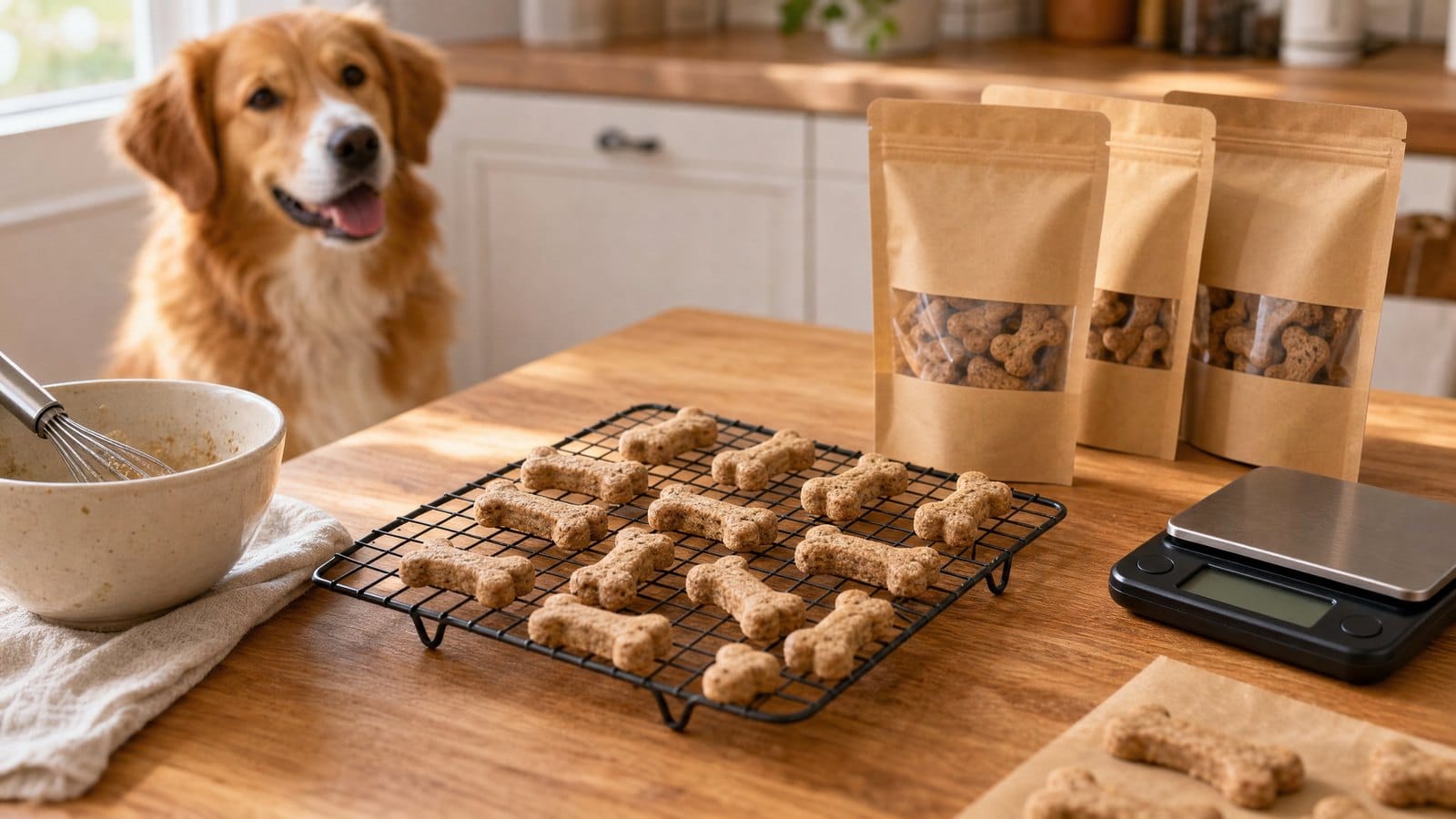
You can sell homemade dog biscuits and cat treats online from a UK home kitchen, but the moment you make them for sale you are a pet food manufacturer in law. Before the first order you register with your local council (Food Standards Scotland if you are in Scotland), and if the recipe contains egg, milk, butter, honey, meat or fish you also need approval from the Animal and Plant Health Agency (APHA). Every pack then needs a statutory statement, and your listing has to show most of it before the buyer pays.
This guide is for people who make treats themselves. For reselling sealed pet food, or each label item explained, see our guide to selling pet products online in the UK. Collars, coats and toys are covered in selling handmade pet accessories online.
Step 1: Work out which recipe route you are on
Your paperwork depends on the ingredients, not on how many bags you sell. Sort every recipe into one of three groups:
- Plant-only baked treats (oat flour, pumpkin, banana, peanut butter): council registration. Business Companion, the Trading Standards guidance service for England, links APHA approval to ingredients of animal origin, so confirm with your council that none of yours count.
- Baked treats with any animal-origin ingredient (egg, milk, butter, cheese, honey, meat, fish, gelatine): council registration plus APHA approval. This applies even if you bought the ingredients in a supermarket and they are fit for people to eat.
- Raw food and chews made from animal parts: APHA approval with its own sampling and packaging rules, plus council registration or approval.
One egg moves a recipe from the first group to the second, so a plant-only range is the quicker start.
Step 2: Register as a feed business before you sell
Pet food manufacture is activity code R6 in the Food Standards Agency guidance on starting an animal feed business, and R codes mean registration rather than approval. The rules differ by nation:
- England and Wales: register with the Trading Standards service of your local council (GOV.UK postcode finder). Business Companion says registration is free; a fee applies only to approval.
- Scotland: all feed businesses have registered with Food Standards Scotland since 1 April 2021. Registration is free, and FSS aims to confirm it with a registration number within 21 days.
- Northern Ireland: GOV.UK says a different process applies, with forms from DAERA, which also publishes its own pet food manufacture guidance.
The FSA exemptions cover feed made at home for your own animals, not treats sold to the public, and Business Companion states that pet food manufacturers must not operate until registered or approved.
Step 3: Apply to APHA if your recipe needs it
The GOV.UK page on using animal by-products to make pet food (updated 3 March 2026, covering England, Scotland and Wales) sets out what approval involves:
- Apply on form ABPR4. You cannot start production until both APHA and the council have granted what you need.
- Use only permitted material: Category 1 and 2 animal by-products and catering waste are banned.
- For processed pet food not sealed in an airtight container (other than dog chews), treat the animal-derived ingredients or the finished product at 90°C. Milk, egg products and gelatine are on the permitted list.
- Send samples to an accredited laboratory for Salmonella and Enterobacteriaceae testing: 10 random sub-samples of 30 g each, at a frequency agreed with APHA.
- For dog chews, prove by sampling that your treatment destroys Salmonella, and keep finished chews apart from raw material.
Business Companion adds that approval needs a documented HACCP plan and ongoing testing at a UKAS-accredited laboratory. Ask APHA about fees before you order labels. In Northern Ireland, ask DAERA.
Step 4: Set up your kitchen, HACCP and records
Feed hygiene law is Regulation 183/2005. Article 6 requires a permanent written procedure based on HACCP principles: identify hazards, find critical control points, set limits, monitor, correct, verify and keep records.
Business Companion says pet food ingredients must be kept strictly separate from household food at every stage: a dedicated kitchen, work area and storage, or time separation with a fully documented clean-down.
A workable record for each batch:
- Batch code, date made and number of packs.
- Ingredient brands and their batch or best before codes.
- Your critical control point check, such as a probe thermometer reading for treats containing egg.
- Cleaning done, by whom and when.
- Who bought each batch.
Ingredients to keep out of dog and cat treats
A 2016 review by Cortinovis and Caloni in Frontiers in Veterinary Science, Household Food Items Toxic to Dogs and Cats, covers the main risks. Keep these out completely:
- Xylitol, a sweetener. Check the label of every shop-bought ingredient, peanut butter included.
- Grapes, raisins, sultanas and currants, linked to kidney failure in dogs.
- Chocolate and cocoa, which contain theobromine and caffeine.
- Onion, garlic, leek and chives. Cooking and drying do not remove the toxic effect, and cats react at lower doses than dogs (about 5 g of onion per kg of body weight against 15 to 30 g/kg). Check stock cubes for them.
- Macadamia nuts, alcohol, raw yeast dough and hops.
If a buyer reports a problem, point them to their vet or the Animal PoisonLine.
Step 5: Write the statutory statement for a treat
A treat is a complementary pet food, not a whole diet. The Business Companion guide to pet food labelling and the UK Pet Food labelling factsheet list the items. On a bag of plant-only dog biscuits (example figures):
- Type and species: Complementary pet food for adult dogs.
- Composition: in descending order of weight, such as oat flour, pumpkin (20%), peanut butter. The percentage is required because the pack name highlights pumpkin.
- Analytical constituents: crude protein, crude fat (or fat content), crude fibre and crude ash, as percentages, plus moisture if over 14%.
- Feeding guidelines: treats per day by dog size, and a note to reduce the main meal.
- Best before: month and year (highly perishable feed takes a "use before" day, month and year).
- Batch number, net weight, and the name and address of your business.
- Contact details: Article 19 of Regulation 767/2009 requires a free telephone number or other appropriate means of communication.
Declared values must fall within legal tolerances, so base them on a laboratory analysis of the finished treat. Raw pet food also needs a statement that it is for pet use only, telling buyers to wash hands and surfaces after handling.
Step 6: Set shelf life and choose packaging
You set the date and must be able to justify it. Run a storage trial: keep packs from a test batch in the bags and conditions buyers will use, check them at intervals for mould, softening and smell, set the best before date well short of the first change, and file the results with your HACCP plan.
GOV.UK requires clean, leak-proof packaging for raw pet food and unused packaging for dog chews. For baked treats, use sealed bags, each with its own label. In a multipack of 10 kg or less, Business Companion says full labelling can go on the outer pack, but each inner pack still needs the type of feed, species, batch number, best before date and net quantity.
Step 7: Price a batch, not a bag
Cost the whole batch, then divide. An example with made-up figures: ingredients £6, bags and labels £8, oven energy £1.50, and 2 hours of your time at £12 an hour (£24) make £39.50 for 20 bags, so £1.98 a bag before profit and selling fees. If you are APHA approved, add a share of each laboratory test bill to every batch. Charge postage separately.
Step 8: Post treats so they arrive fit to eat
Royal Mail's guidance on sending food by post treats biscuits and dried foods as non-perishable. For perishable items such as raw food:
- Use Tracked 24 or Tracked 48 as the minimum; food must withstand up to 48 hours in transit.
- Cool with frozen gel packs only. Dry ice and frozen water are not allowed.
- Seal against leaks, use a strong corrugated box or polystyrene pack, show your return address and mark it PERISHABLE.
- Do not send perishable food abroad with Royal Mail.
On returns, the Consumer Contracts Regulations 2013, regulation 28 exclude goods liable to deteriorate rapidly from the cancellation right, and hygiene-sealed goods lose it once unsealed. A biscuit with months of shelf life is not obviously "rapidly deteriorating", so cover sealed and opened packs separately in your returns policy.
Step 9: Photograph and word the listing
For distance sales, Article 11 of Regulation 767/2009 requires most mandatory label details to appear in the listing before the contract (batch number and best before date are among the exceptions). Type the statutory statement into the description and add a photo of the back label.
- Title: species, type, main ingredient and weight, for example "Pumpkin and Oat Dog Biscuits, 150 g, Complementary Pet Food".
- Photos: pack front, back label readable at full size, one treat beside a ruler, an open bag.
- Description: treat size in centimetres, treats per bag, storage once opened.
Our post on why listings get no views covers titles and categories.
Claims you must not make
Article 13 of Regulation 767/2009 bans any claim that pet food will prevent, treat or cure a disease. Other claims must be objective, verifiable and backed by scientific evidence you can produce on request. Article 11 also bars presenting qualities all similar treats share as special.
- Not allowed: "cures itchy skin", "prevents arthritis", "treats worms". Parasite treatments are veterinary medicines.
- Needs evidence: "supports healthy joints", "for shiny coats", "calming".
- Needs a percentage: "with salmon", "made with real cheese".
- Safer wording: facts about ingredients and method, such as "baked in small batches, 3 ingredients", if true.
Selling on MC999
MC999 is a UK online marketplace with no commission on sales. Sellers pay a monthly fee based on the scale of their business. If you run a Shopify, BigCommerce or Shopline store, you connect it and buyers complete the purchase on your own website. Without a web shop, you list items manually and arrange payment with the buyer directly. The first 300 approved UK sellers get the monthly fee free for 6 months as Founding Sellers.
FAQ
Does a vegan dog biscuit need APHA approval?
Business Companion ties APHA approval to ingredients of animal origin, such as eggs, milk, butter, honey and meat. A recipe with none of these should need council registration only. Confirm it with Trading Standards when you register, and recheck if you change the recipe.
Who can check my label before I start selling?
Trading Standards (Food Standards Scotland in Scotland) enforces the labelling rules and gives business advice, so send a draft label when you register. Business Companion also points makers to the Code of Good Labelling Practice for Pet Food.
Can I add a treat to my handmade toy orders as a free gift?
A free treat is still pet food you have made and supplied, so the same registration and labelling apply. Pack it in its own labelled bag rather than loose in the parcel.
Sources (checked 2 November 2026)
- GOV.UK: Using animal by-products to make pet food
- GOV.UK: Register an animal feed business
- Food Standards Agency: Starting an animal feed business
- Food Standards Scotland: Registration and approval of feed businesses
- DAERA: Pet food manufacture
- Business Companion: Manufacturing your own pet foods
- Business Companion: Retail sale of pet food
- UK Pet Food: Understanding pet food labels factsheet
- Regulation (EC) No 183/2005, Article 6 (HACCP)
- Regulation (EC) No 767/2009, Article 11 (labelling principles and distance selling)
- Regulation (EC) No 767/2009, Article 13 (claims)
- Regulation (EC) No 767/2009, Article 19 (contact details on pet food)
- Consumer Contracts Regulations 2013, regulation 28
- Royal Mail: Sending food and perishable items in the post
- Cortinovis and Caloni (2016), Household Food Items Toxic to Dogs and Cats, Frontiers in Veterinary Science
- Animal PoisonLine (Veterinary Poisons Information Service)