Detailing Business Basics: Selling Directly to UK Car Owners
What to decide before you sell detailing products under your own name: duties for own-brand chemicals, tax registration, insurance, a starter range and the full cost per bottle.
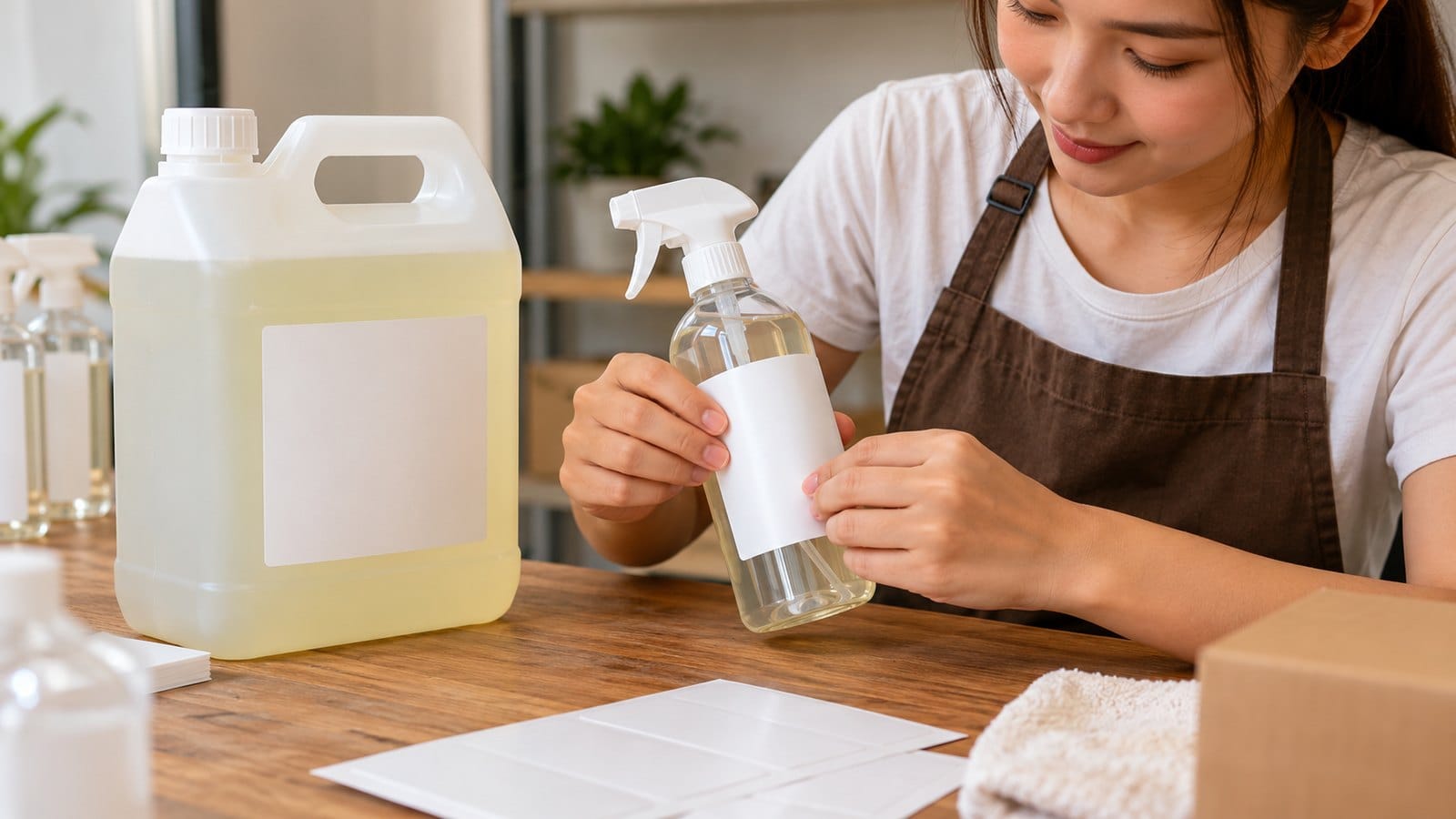
If you want to sell car care products such as snow foam, interior cleaner, wheel cleaner, cloths and brushes to UK car owners online, decide first whether you will resell sealed products from a supplier or fill bottles under your own brand. Both work for a small seller, but the paperwork is very different, so decide before you buy any stock.
Reselling sealed products or bottling your own
Reselling is the simpler route. You buy sealed products from a UK supplier and sell them unopened, so the manufacturer or importer has already classified and labelled them. You still have a few jobs: check that each label is in English and suitable for the GB market, keep the supplier's safety data sheet on file and describe the product accurately in your listing.
Putting your own label on the bottle takes more work, and most of it comes from the law rather than from filling and labelling. Once your name is on the bottle, you take on duties that a reseller of sealed products does not have.
What changes when your name is on the label
Two laws explain most of it. Anyone who puts their name, trade mark or other distinctive mark on a product, and so presents themselves as its manufacturer, counts as a producer (General Product Safety Regulations 2005, regulation 2). Under section 2 of the Consumer Protection Act 1987, a producer, including someone who holds themselves out as the producer, is liable for damage caused by a defect in the product in the same way as the actual maker. Put your logo on a bottle and the law can treat you as the maker.
Chemical labelling comes on top. HSE says the GB CLP rules on classification, labelling and packaging apply to manufacturers, importers, downstream users and distributors supplying the GB market; products placed on the market in Northern Ireland follow the EU CLP Regulation. The label on a hazardous mixture must be in English and give the supplier's name, address and telephone number and the product identifier (GB CLP Article 17). If you sell to the general public, it must also show the nominal quantity unless that appears elsewhere on the pack and, where they apply, the hazard pictograms, signal word, hazard statements and precautionary statements (HSE: the hazard label).
The rules also cover packaging. It must hold the contents and not be weakened by them, and a re-closable cap must still seal after repeated opening. Packaging for the general public must not attract children, mislead consumers or look like food, drink or cosmetics packaging. Some hazard classes also need a child-resistant fastening, a tactile warning for blind and partially sighted people, or both (HSE: packaging).
A hypothetical example: you buy snow foam in 5 litre containers and decant it into 500 ml bottles printed with your own brand. With your name on the label, you need the supplier's classification and safety data sheet for the mixture, a hazard label made for the 500 ml size, bottles the chemical will not damage, and a safety data sheet ready for anyone who buys it for use at work. A mobile valeter buying from you is covered by HSE guidance on safety data sheets, which says they must be provided for hazardous chemicals supplied for use at work.
In practice this becomes a routine for every batch: pour from the 5 litre container, fit the triggers, apply the labels and mark a batch number on each bottle. It takes time by hand, but if a customer reports a problem, the batch number tells you which bottles came from the same container. Pack each bottle so that a leak stays inside, for example in a sealed bag inside the carton.
Keep records as you go, on your computer or on paper:
- supplier invoices that show the batch numbers
- each version of the safety data sheet
- proofs of your printed labels
- the date of each label change
Start with a small range and get it right before you list
There is no legal minimum number of products. One approach is to build your first range around one job, such as cleaning a car interior. A hypothetical starter range for that job:
- interior cleaner, ready to use, 500 ml
- glass cleaner, 500 ml
- dashboard and trim protector, 250 ml
- microfibre cloths, pack of 6
- soft detailing brush set
Only the first three are chemical mixtures; GB CLP does not apply to the cloths and brushes. If the interior range sells, add another job, such as wheel cleaning, and run the same checks.
Before each chemical goes live, have a clear photo of the label, the size, the dilution ratio, the surfaces it suits and a carrier you have confirmed will take it. Our guide to selling car detailing products online in the UK covers labels, safety data sheets and carriers in more detail.
Before an online order is placed, you must give buyers your business name, contact details and address, the price including all taxes, the delivery arrangements and costs, and how to cancel (GOV.UK: online and distance selling). Buyers generally have 14 days from the day they receive the goods to cancel.
Royal Mail restricts goods that display hazard warning symbols, and the rules vary between services (Royal Mail: prohibited and restricted items), so you will usually need to set delivery options product by product rather than once for the whole shop.
You can sell through your own shop, where you keep the customer relationship, through marketplaces, or at local car meets and shows. Keep the size, dilution ratio and price consistent everywhere, so a buyer who meets you at a show can find the same product online afterwards.
Working out the money
A hypothetical example for a 500 ml own-brand interior cleaner made by diluting a concentrate 1 to 9 (figures for illustration only): at £12 a litre, the 50 ml of concentrate in each bottle costs £0.60. The bottle and trigger cost £0.85, the printed label £0.30 and packing materials £0.40. If you offer free postage, add £3.20. That makes £5.35 before selling and payment fees, which vary by channel, so take them from each platform's current fee page.
Sold at £9.99, that leaves £4.64 for fees, returns, insurance and your time. Once you are VAT registered, the price buyers see has to include VAT, so recheck the margin then.
On tax, you can start trading as a sole trader straight away, and you must register for Self Assessment if your trading income is more than £1,000 in a tax year, 6 April to 5 April (GOV.UK: set up as a sole trader); the trading allowance covers up to £1,000. You must register for VAT if your taxable turnover is over £90,000 in the last 12 months. Making Tax Digital for Income Tax has applied since 6 April 2026 to sole traders with qualifying income over £50,000; the threshold falls to £30,000 from 6 April 2027 and £20,000 from 6 April 2028. Keep your records for at least 5 years after the 31 January deadline for the tax year.
As a sole trader you have unlimited liability, so you are personally responsible for any business debts. A limited company is a separate legal entity, and its owners are only liable for what they have invested (GOV.UK: business legal structures). Talk to an accountant before you launch an own brand.
On insurance, a small seller's main exposure is product liability and public liability: for example, a customer says a wheel cleaner marked their alloys, or a bottle leaks in transit onto someone else's parcel. Ask your insurer to confirm in writing that rebottled or own-brand chemicals are covered, and sales at car shows too.
Listing your products on MC999
Honest listings and clear labels help car owners decide whether a product suits their car. You can also list your detailing products on MC999, a UK marketplace where shoppers discover products and the independent shops behind them. If your shop runs on Shopify, Shopline or BigCommerce, you can connect it, and shoppers who find a product on MC999 go to your own shop to buy. You can also add products manually; the How to Sell guide covers both.
Already selling through your own shop? See how to add your products to MC999 and give shoppers another way to find your business.
Frequently Asked Questions
Do I need insurance to sell detailing products online?
If you employ someone, you need employers' liability insurance with cover of at least £5 million from an authorised insurer, and you can be fined £2,500 for every day you are not properly insured (GOV.UK: employers' liability insurance). You do not need it if your only employee is a close family member. If you work alone, ask an insurer about product and public liability cover.
How small can my catalogue be to start?
As small as you like: there is no legal minimum. A range built around one job, such as cleaning a car interior, is a sensible start, as long as each chemical listing has its label photos, size and dilution ratio ready.
Can I run the business from home?
Often, but check first. GOV.UK says you may need planning permission, for example if you make major changes or have many customer visits, and you may have to pay business rates on the part of your home you use for the business (GOV.UK: running a business from home). You may also need permission from your mortgage provider or landlord, and home insurance may not cover stock.
Sell on MC999
Ready to start selling without paying commission on every sale? Join MC999 as a Founding Seller and keep full control over your prices, delivery and returns.