Hallmarking Rules for Selling Jewellery Online in the UK
Selling gold, silver, platinum or palladium online? Check exemption weights, read the marks, register a sponsor's mark, show the Dealer's Notice, word plated and vermeil pieces correctly and handle pre-owned items under the Hallmarking Act 1973.
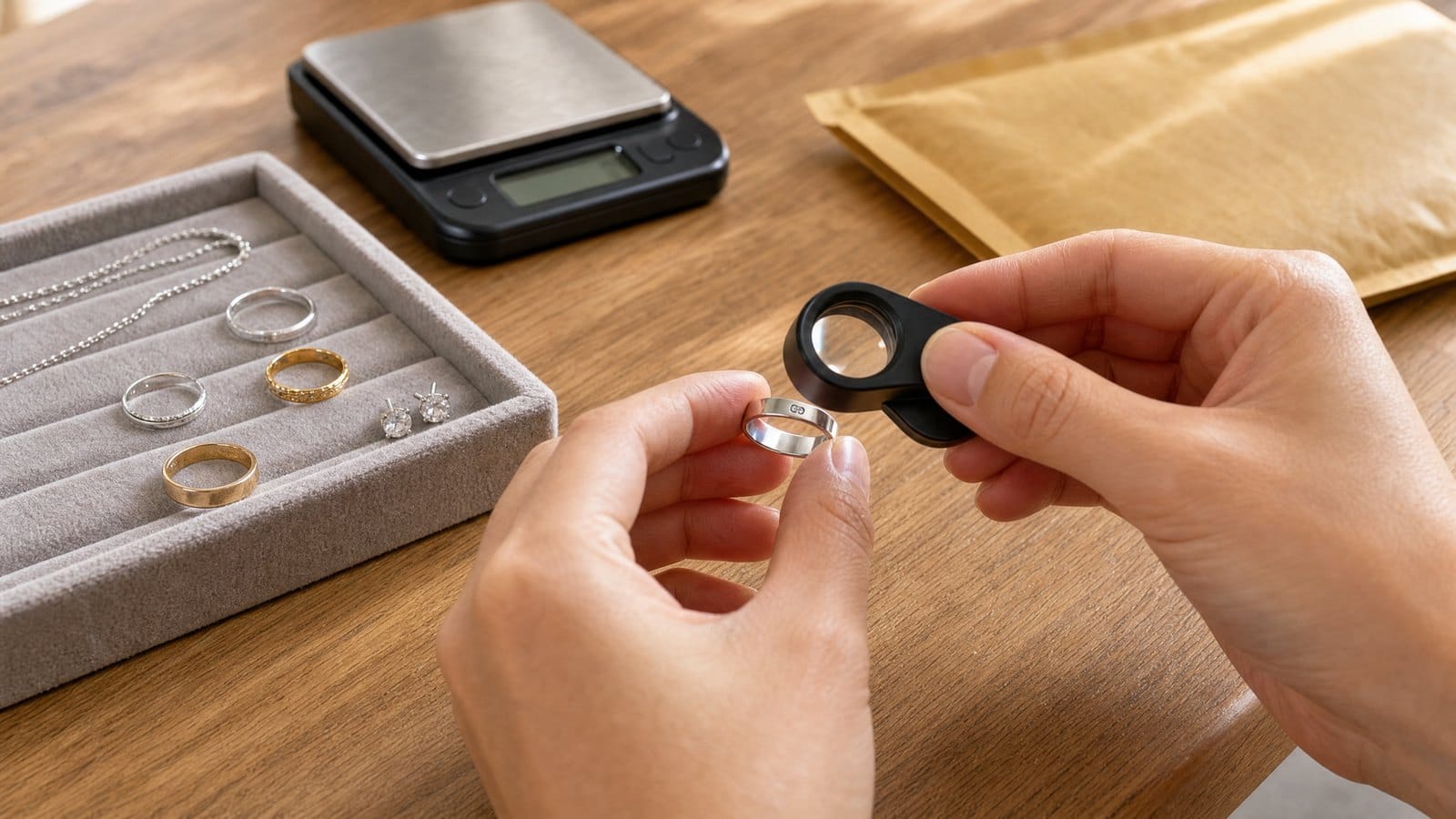
To sell gold, silver, platinum or palladium jewellery online in the UK as a business, every piece you describe as one of those metals must carry approved UK hallmarks unless it is exempt, most often because its total metal weight is under 1 gram for gold or palladium, 7.78 grams for silver or 0.5 grams for platinum. You must also show the British Hallmarking Council's Dealer's Notice on your shop, and word plated or colour-only pieces so they do not claim a precious metal. This guide puts those checks in the order you would do them, from weighing a piece to sending a batch to an Assay Office.
If you are new to selling jewellery, our guide to selling jewellery online in the UK covers measurements, returns and general photography, and the guide to starting an online jewellery business covers branding and sourcing. This one goes deeper into the hallmarking law itself.
Step 1: Decide whether a piece needs a hallmark
The offence in section 1 of the Hallmarking Act 1973 covers two acts. You commit it if, in the course of a trade or business, you describe an unhallmarked article as wholly or partly gold, silver, platinum or palladium, or supply or offer to supply one with that description. The British Hallmarking Council's guidance on internet sales says jewellery sold online will usually be sold in the course of a business, so the rule applies to most web shops and marketplace sellers. Check each piece in this order:
- Is a precious metal mentioned anywhere? The title, description, tags and a fineness stamp all count. The Assay Offices' Hallmarking Guidance Notes confirm that a manufacturer's fineness mark, such as a "925" stamp, is itself a description.
- Is the metal under the exemption weight? Schedule 1, Part II exempts articles of minimum fineness weighing less than 1 gram of gold, 7.78 grams of silver, 0.5 grams of platinum or 1 gram of palladium. The Guidance Notes say the figure is the total metal weight, including any base metal parts.
- Does it mix precious metals? The threshold of the most precious metal applies to the combined weight. The Guidance Notes give the example of 0.5 grams of gold and 3 grams of silver: the gold threshold of 1 gram applies, the total of 3.5 grams exceeds it, so the piece needs a hallmark.
- Does another exemption apply? Schedule 1 also exempts coins that are or were legal tender (see our guide to selling coins online), articles so small or thin they cannot be marked (chain is excluded from this one), and items intended for despatch outside the UK.
Example: a sterling silver ring with 6 grams of metal is exempt and can be described as silver. Add a 0.4 gram 9ct gold detail and it is no longer exempt, because the gold threshold of 1 gram now applies to 6.4 grams of metal.
In Great Britain the Act is enforced by local Trading Standards, and section 9 also lets the British Hallmarking Council and the Assay Offices enforce the Act.
Step 2: Read the marks on the piece
Under section 2, an article counts as unhallmarked unless it bears the approved hallmarks and a sponsor's mark. The Guidance Notes list three compulsory marks:
- Sponsor's mark: the maker or sponsor, shown as at least two letters inside a surround.
- Fineness mark: a number in parts per thousand, such as 375, 585 or 750 for gold, 925 or 958 for silver, 950 for platinum or 500 for palladium. The shape of the surround shows which metal it is.
- Assay Office mark: Schedule 2 sets these as a leopard's head for London, an anchor for Birmingham, a rose for Sheffield and a castle for Edinburgh.
Optional marks may sit alongside: a crown for gold, a lion passant for sterling silver (a lion rampant if struck in Edinburgh), Britannia for 958 silver, an orb for platinum, the head of Pallas Athene for palladium, and a date letter. The date letter was compulsory until 1999, according to the Guidance Notes, and its absence does not make a modern piece unhallmarked.
Marks from abroad: section 2 also recognises International Convention hallmarks, which carry the Common Control Mark (a pair of scales) with a sponsor's mark and Assay Office mark, and EEA hallmarks struck before the UK left the EU. A bare "925" or "750" stamp from an overseas factory is neither.
Step 3: Get pieces hallmarked at a UK Assay Office
- Pick one office. Each Assay Office keeps its own register, and Sheffield Assay Office advises registering with the office you will use regularly.
- Register a sponsor's mark. Section 3 requires one before items are hallmarked and makes registration last ten years. Fees differ: London Assay Office charges £72 including VAT with laser set-up for standard designs, while Sheffield charges £100 plus VAT, £50 plus VAT for laser set-up and typically £80 to £95 plus VAT for a punch.
- Group the batch. London's rule is "one metal, one standard, one hallnote", and new and second-hand goods go on separate hallnotes. Send every component of an unassembled piece, because each part is tested.
- Check your supplier's plating. The Guidance Notes say Assay Offices reject articles with base metal under the plating, such as a nickel or copper interlayer. Write this into overseas supplier orders.
- Send and pay. London accepts Royal Mail Special Delivery, couriers and hand delivery, and gives a standard turnaround of typically 5 to 10 working days. Payment is due before items are released.
Step 4: Put the Dealer's Notice on your shop
Section 11 requires every dealer to display the British Hallmarking Council's notice explaining approved hallmarks, and failing to do so is an offence. The Council's internet guidance treats a website as the dealer's premises. GOV.UK says online retailers can use Dealer's Notice A or Dealer's Notice B, which comes as a PDF or a short film for platforms where a dedicated hallmarking page is not required. The current version became compulsory on 1 May 2020, so replace any older copy.
- Your own website: create a hallmarking page with the notice and link it from the footer and from every precious metal product page.
- Marketplace listings you create by hand: Sheffield Assay Office says the digital notice is designed to be included as an individual product image, so add it as the last photo of each listing.
- Getting the file: both versions are free downloads, for example from London Assay Office's downloads page. GOV.UK requires Notice A to be reproduced in full with no amendments, additions or deletions; treat Notice B the same way and do not crop it.
Step 5: Word the listing so the description matches the metal
Schedule 1 fixes what some words mean. "9 carat" is presumed to mean 375 parts per thousand, 14 carat 585, 18 carat 750 and 22 carat 916.6. "Sterling" is presumed to mean silver of 925 and "Britannia" silver of 958.4. Section 1 treats any overstated fineness as misleading, so a 375 piece cannot be listed as 10ct.
For anything that is not solid precious metal:
- Plated base metal: "gold plated", "rolled gold", "silver plated" and similar are allowed, and in writing the word "plated" or "rolled" must be at least as large as the rest of the description. The Guidance Notes add that 10k bonded gold can only be described as 9 carat in the UK.
- Gold plated silver and vermeil: the description must say silver, and "gold" must be followed directly by "plated", for example "18ct gold plated silver ring". "Vermeil" may be added but cannot replace those words, and "22ct gold vermeil ring" is given as a misleading example. "Silver gilt" is allowed if no gold fineness is stated.
- Colour only: a base metal watch listed as a "gold watch" is an offence, according to the Guidance Notes. "Gold tone", "gold coloured" or "yellow metal" are their suggested alternatives.
Example title for an exempt piece: "Sterling silver stud earrings, 925, 1.8 g total metal weight". Example for a hallmarked piece: "18ct gold signet ring, London hallmark, 750, 6.2 g".
Photographs that prove the description
- A sharp close-up of the hallmark with every mark readable. On rings this is usually inside the shank.
- For exempt pieces, a photo of the item on a scale showing the gram reading.
Second-hand and antique pieces
The Guidance Notes state that the rules apply equally to pre-owned articles.
- Pre-1950 items: an unhallmarked piece of gold or silver can be described as such if it is of minimum fineness (375 for gold, 800 for silver) and was made before 1950 without improper alteration since. Schedule 1 presumes manufacture was after that date until the contrary is proved, so keep your evidence.
- Older date-based exemptions: Schedule 1 also exempts platinum articles made before 1 January 1975, palladium articles made before 1 January 2010, and some gold pieces made before 1975, such as rings other than wedding rings.
- Alterations: an improperly altered piece counts as unhallmarked under section 2. Section 5 allows additions to an article that is not new ware if it keeps its character, the added metal is the same metal and at least the same fineness, and the addition is no more than 1 gram of gold, 5 grams of silver, 0.5 grams of platinum or 1 gram of palladium, and no more than half the article's weight. A coating up to 2 micrometres, such as re-rhodium plating a white gold ring, is also allowed. Anything bigger needs an Assay Office's written consent.
- Doubtful marks: under section 7, a dealer who offers a piece bearing marks that an Assay Office could cancel, because they were not struck lawfully or the piece has been improperly altered, commits an offence unless it was first submitted to an Assay Office. Jewellery made from hallmarked cutlery must also go to an Assay Office before sale, according to the Guidance Notes, which say the office issues a certificate for the buyer.
London Assay Office takes second-hand submissions at Goldsmiths' Hall only, typically at least 7 to 12 working days.
Where MC999 fits
MC999 is a UK online marketplace with no commission on sales; sellers pay a monthly fee based on the scale of their business. If you run a Shopify, BigCommerce or Shopline store, you connect it and buyers complete the purchase on your own website, so your own hallmarking page stays part of the sale. Without a web shop, you can list items manually, with the Dealer's Notice as a listing image, and arrange payment with the buyer directly. See how independent sellers list in the Jewellery and Watches category. The first 300 approved UK Founding Sellers get the monthly fee free for 6 months: see how to become a Founding Seller.
FAQ
Does the weight of stones count towards the exemption weight?
The Guidance Notes and the British Hallmarking Council both base the exemption on the weight of the metal, including any base metal parts. If you cannot weigh the metal separately, for example in a set ring, ask an Assay Office before you list it as exempt.
Can I sell an imported ring stamped 925 without a UK hallmark?
Only if it is under 7.78 grams of total metal or meets another exemption. A factory "925" stamp is a description, not an approved hallmark, unless it forms part of a recognised Convention hallmark. Otherwise send it to an Assay Office before describing it as silver.
Can I describe a pre-1950 brooch with no hallmark as gold?
Yes, if it is at least 375 gold and has not been improperly altered since 1950. The law presumes it was made after 1950 until shown otherwise, so you need evidence of age. An Assay Office can test the fineness and hallmark it if you cannot prove the date.
Sources (checked 2 November 2026)
- Hallmarking Act 1973, section 1: prohibited descriptions of unhallmarked articles
- Hallmarking Act 1973, section 2: approved hallmarks, Convention and EEA hallmarks, improper alteration
- Hallmarking Act 1973, section 3: sponsors' marks and ten-year registration
- Hallmarking Act 1973, section 5: alterations to hallmarked articles
- Hallmarking Act 1973, section 7: unauthorised marks
- Hallmarking Act 1973, section 9: enforcement
- Hallmarking Act 1973, section 11: Dealer's Notice
- Hallmarking Act 1973, Schedule 1: permitted descriptions, exempt articles, carats, sterling and Britannia
- Hallmarking Act 1973, Schedule 2: approved hallmarks and Assay Office marks
- GOV.UK: Hallmarking, how businesses can comply with the law
- UK Assay Offices: Hallmarking Guidance Notes, November 2022 (PDF on GOV.UK)
- British Hallmarking Council: selling articles of precious metal on the internet (PDF on GOV.UK)
- London Assay Office: hallmarking steps, fees and turnaround
- London Assay Office: Dealer's Notice A and B downloads
- Sheffield Assay Office: getting started with hallmarking, fees
- Sheffield Assay Office: digital Dealer's Notice for online sales