How to Sell Collectibles Online in the UK: A Complete Guide
Before you sell collectibles online in the UK, check the item is not restricted, work out whether you are a trader, and describe every flaw. Pricing, consumer rights and posting valuables explained.
Before you sell collectibles online in the UK, check three things: whether the item is restricted, whether you are selling as a collector or as a trader, and whether your description covers every fault. This guide is for collectors and small sellers dealing in coins, stamps, cards, toys, memorabilia, antiques and military items. Some rules differ in Scotland and Northern Ireland, so check locally if you sell from there.
Items that need extra care before you list them
Ivory
Under the Ivory Act 2018, dealing in ivory is banned unless the item is exempt, and dealing includes advertising an item for sale and inviting offers. The ban now covers ivory from five species: elephant, hippopotamus, killer whale, narwhal and sperm whale; it originally covered elephants only.
Some items can be registered for sale under a standard exemption, which costs £20 per item. Items made before 1918 that are of outstandingly high artistic, cultural or historic value can be sold with an exemption certificate, which costs £250, takes about three months, and must be in hand before you sell. The maximum penalty for dealing without an exemption is a £250,000 fine or 5 years in prison (GOV.UK: dealing in items containing ivory).
Knives and bladed items
You must not sell most knives, or any weapon, to anyone under 18. Some items can never be sold, including flick knives, gravity knives, push daggers, ninja swords, and zombie knives and zombie-style knives and machetes. Curved swords with a blade of 50 cm or more are also banned, with limited exceptions. Antique weapons more than 100 years old are generally exempt, except flick knives and gravity knives (GOV.UK: buying and carrying knives). Business Companion advises checking with the police before you sell an antique blade.
It is also an offence for a seller to deliver a bladed product to residential premises after a remote sale (Offensive Weapons Act 2019, section 38). Premises used to run a business are not residential for this purpose. Your local Trading Standards service can advise on specific cases.
The Crime and Policing Act 2026 adds photo ID checks for online sales of knives and other bladed products: sellers will have to check a buyer's passport or UK driving licence and a current photograph, and the courier must check photo ID on delivery. These provisions were not in force when the Act received Royal Assent, so check their status before you list a blade (Home Office factsheet).
Deactivated and imitation firearms
A deactivated firearm can only be sold to someone aged 18 or over, and making a defectively deactivated weapon available for sale is an offence. Selling a realistic imitation firearm is also an offence under the Violent Crime Reduction Act 2006 unless a defence applies, such as use by a museum or in a theatrical performance or film production (Home Office: guide on firearms licensing law).
Replica money
It is an offence to pass on, without lawful authority or excuse, anything you know or believe to be a counterfeit of a currency note or a protected coin (Forgery and Counterfeiting Act 1981, section 15). Reproducing any British currency note, or part of one, at any size is also an offence without written consent from the issuing authority (section 18). Take advice before you sell a replica note or coin.
A note on vintage toys
The Toys (Safety) Regulations 2011 set safety requirements for toys, but Schedule 1 excludes some products, including items clearly intended for collectors that show an age group of 14 years and above on the product or packaging. Business Companion notes that second-hand toys are covered for safety by the General Product Safety Regulations 2005. If you are selling a toy as a collector's piece rather than a child's toy, say so in the listing.
Describe condition and authenticity honestly
If you sell as a trader, goods must match their description and be of satisfactory quality, judged by what a reasonable person would expect given the description, the price and other relevant circumstances (Consumer Rights Act 2015, sections 9 and 11). Faults you point out before the sale are not covered by the satisfactory quality term, so list every fault.
Under the Digital Markets, Competition and Consumers Act 2024, a misleading action by a trader can be a criminal offence, and that includes accurate information presented in a misleading way. Business Companion confirms the rules apply to anyone trading in antiques and collectibles (Business Companion: antiques and antiquities).
There is no legal definition of "antique". Business Companion notes that many people use 100 years or more as the test, and that collectible or vintage items can be much more recent.
If an item has been graded, name the grading company and give the exact grade and certificate number. Words such as "genuine", "original" or "rare" may be accurate, but you must be able to back them up with evidence.
Record any repairs or restoration and tell the buyer about them, ideally in writing; Business Companion gives antique dealers the same advice.
Photograph every flaw
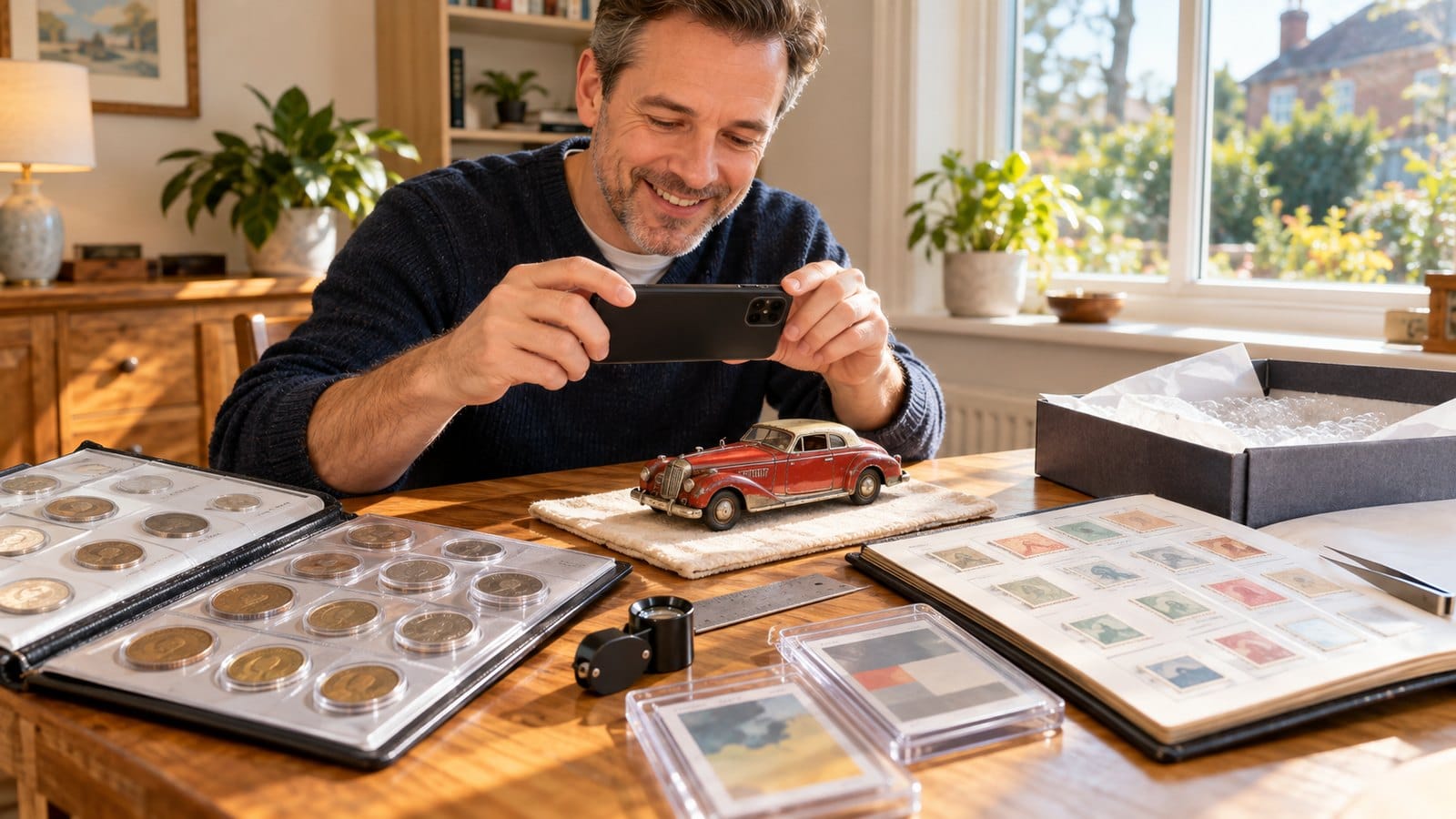
Photograph the item against a plain background in good light, and include:
- the whole item, front and back
- close-ups of every flaw, such as chips, creases, scratches or tarnish
- marks, maker's stamps, dates and serial numbers
- any certificate, grading label or case, front and back
- a ruler or coin beside the item for scale
Do not edit out wear.
Pricing a collectible
Compare your price with completed sales of the same item: the same year, edition, model and colour, and the same completeness, such as packaging and paperwork. Sold prices show what buyers actually paid; asking prices only show what sellers hope to get.
Then adjust for any flaws your item has that the sold examples did not, and for rarity. Evidence that the item appears in a recognised catalogue can support your price.
You can change the price of a fixed-price listing at any time. In an auction-style listing, bidders set the price until the auction closes at its set date and time.
Collector or trader?
HMRC is likely to treat someone who buys items intending to sell them at a profit as trading. Selling personal possessions, such as the contents of a loft or garage, is unlikely to be trading (HMRC: income from online platforms).
HMRC's Business Income Manual lists "badges of trade" that point towards trading, including selling large numbers of similar items, reselling soon after buying and repairing items in order to resell them. Items held for a long time, or received as a gift or inheritance, are much less likely to be part of a trade (BIM20205).
If your total trading income in a tax year is more than the £1,000 trading allowance, you must tell HMRC.
Since 1 January 2024, online platforms have reported sellers' details to HMRC, unless a seller makes fewer than 30 sales in a calendar year and receives less than about £1,700 (€2,000) from them. A report does not mean you owe tax.
Separately, Capital Gains Tax may apply when you sell a personal possession for more than £6,000; the same limit applies to a set of items that belong together, sold as a set.
Consumer law draws a sharper line. A business seller has many duties under consumer law. A private seller selling to another consumer has far fewer: the item must not be misdescribed, and the seller must have the right to sell it. It is illegal for a business to pretend to be a private seller.
A trader selling at a distance must also give a 14-day cancellation period, starting when the goods arrive. The exceptions in regulation 28 of the Consumer Contracts Regulations 2013 cover certain types of goods, but not collectibles in general. If you do not tell buyers about the right to cancel, the period can extend by up to 12 months.
Packing and posting valuable items
Put each item in its own holder inside a rigid outer box, centred, with padding between the item and the sides. Pack flat paper items such as prints between layers of stiff card in a box of the right size.
Do not describe the contents on the outside of the parcel. Use a tracked service with a signature on delivery, and read the carrier's terms before you pay: note the compensation limit for loss or damage and any exclusions. If the limit is below the item's value, consider buying extra cover.
If you sell as a trader, Business Companion notes that you remain liable to the buyer for loss or damage in transit, even when the carrier is at fault (Business Companion: selling goods via online platforms).
Another way to be found
Accurate descriptions and honest photos help collectors buy with confidence. You can also list your items on MC999, a UK marketplace where shoppers discover products and the independent shops behind them. You can add products manually or connect a shop that runs on Shopify, Shopline or BigCommerce, alongside the channels you already sell on. The How to Sell guide covers both.
Already selling through your own shop? See how to add your products to MC999 and give shoppers another way to find your business.
Frequently Asked Questions
Do I need proof of authenticity before listing a collectible?
The law looks at what you claim. If you sell an item with a guarantee of authenticity, Business Companion says you need evidence that it has been examined and is genuine. If you have any doubt about an item's authenticity, say so in the listing.
Is it better to sell collectibles at auction or at a fixed price?
Both can work; choose by how many sold comparisons you can find for the item. Public auctions, which buyers attend or can attend in person, do not have to offer the 14-day right to cancel, but auction-style listings on online marketplaces do not count as public auctions.
What happens if a buyer says my collectible is not as described?
If you sold as a trader, the buyer can reject goods that are not as described and get a full refund within 30 days, counted from the day after delivery, and you must pay the reasonable cost of returning them (Consumer Rights Act 2015, section 22).
Sell on MC999
Ready to start selling without paying commission on every sale? Join MC999 as a Founding Seller and keep full control over your prices, delivery and returns.