How to Sell Trading Cards Online in the UK
A practical guide to selling Pokémon, Magic, Yu-Gi-Oh! and sports cards in the UK: exact card details, honest condition, when grading pays, fakes and resealed packs, sold-price pricing, photos, and postage cover that matches the card's value.
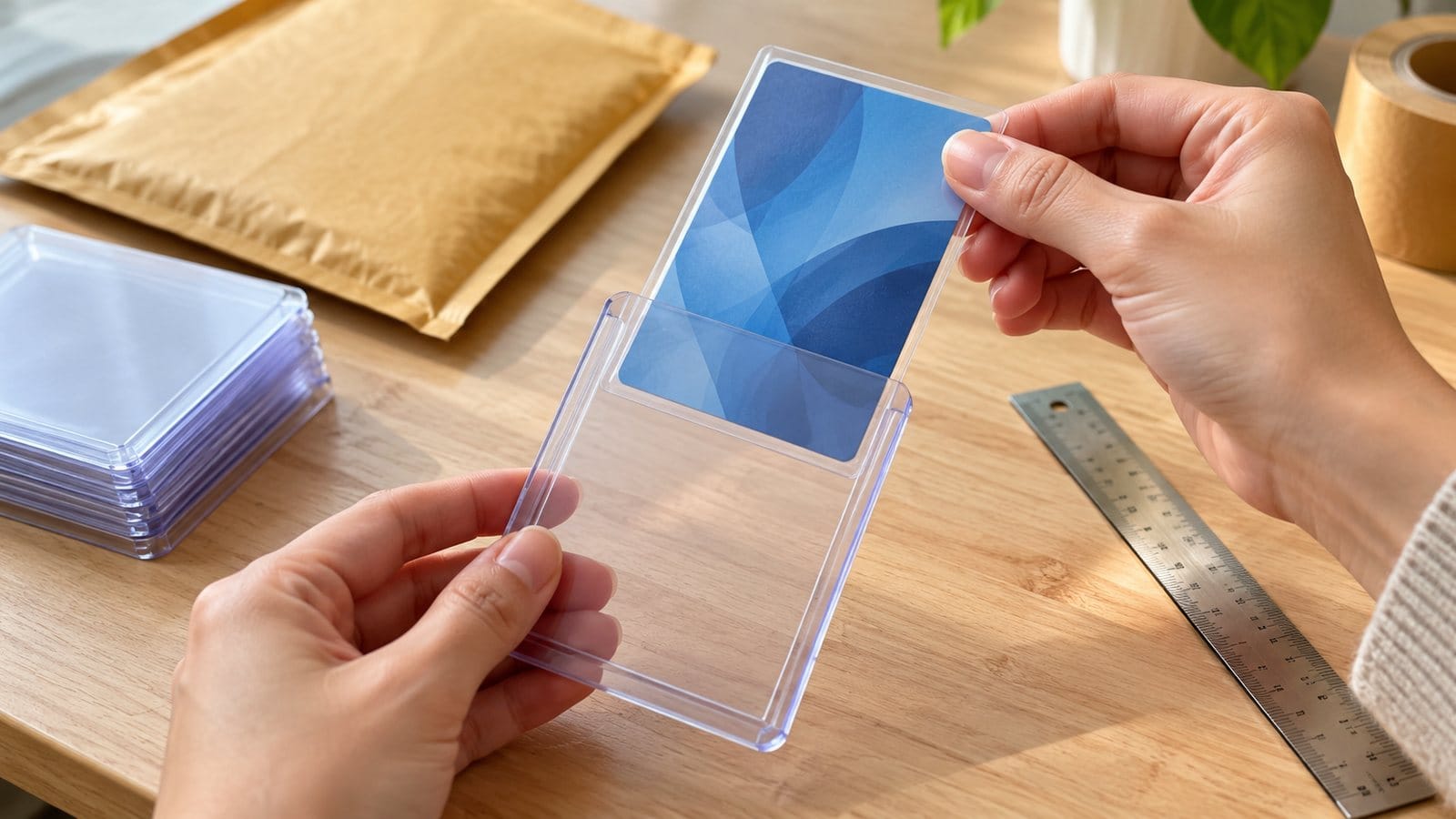
To sell trading cards online in the UK, identify each card exactly, describe its condition by the defects you can see, price it based on recent sold prices for the same card in the same condition, and post it in a sleeve and toploader with cover that matches its value. Before you list, decide whether a card is worth grading, and make sure nothing you sell is a fake, a proxy or a resealed pack. The steps apply to Pokémon, Magic: The Gathering, Yu-Gi-Oh!, football and other sports cards.
Identify each card exactly
Two cards with the same name can differ a great deal in price, so the title and description need the details that separate them. Take them from the card itself:
- the game or brand, and the set name or set symbol
- the card number printed on the card, for example 4/102 on a Pokémon card
- the edition or print run, such as a 1st Edition stamp
- the language
- the finish: holo, reverse holo, foil or non-foil
- any serial number, for example 12/99 on a numbered sports card
- the year, for sports cards
A title such as "Pokémon Base Set Charizard 4/102, Unlimited, English, holo" lets a collector see at once whether it is the card they want. "Rare vintage Charizard" does not.
Describe condition by what you can see
Words such as near mint, excellent or lightly played are shorthand, and buyers and sites use them slightly differently. Give your word, then back it up with what you see in four areas:
Centring: how even the borders are, front and back.
Corners: sharp, slightly soft or rounded.
Edges: any whitening or chipping, which shows most on cards with dark borders.
Surface: scratches, print lines, dents, creases, staining and loss of gloss.
PSA's description of its top grade gives a sense of how strict the top end is. A Gem Mint 10 must have "four perfectly sharp corners" and "full original gloss", no staining, and the picture centred within about 55/45 on the front and 75/25 on the back (PSA grading standards).
If you sell as a trader, the card must match your description, and calling it near mint when the back is scuffed can count as a misleading action, which can be a criminal offence (Consumer Rights Act 2015, section 11; Digital Markets, Competition and Consumers Act 2024, sections 226 and 237). Faults you point out before the sale are not covered by the satisfactory quality term, so name every fault, even the small ones (Consumer Rights Act 2015, section 9).
Raw or graded?
A graded card has been assessed by a grading company, given a grade and sealed in a plastic case, often called a slab, with a label showing the grade and a certificate number. A raw card is ungraded.
Grading costs a fee plus insured postage both ways, and it takes time. It makes sense when the graded card sells for more than the raw card by a clear margin after those costs. Work it out before you send anything.
For example, take a hypothetical card that sells for about £40 raw in near mint condition, while the same card graded 9 has recent sold prices around £90. Suppose grading and insured postage both ways cost £35 in total. If it comes back a 9, £90 minus £35 leaves £55, which is £15 more than selling it raw. If it comes back an 8 that sells for £50, you are left with £15, which is £25 less than selling it raw. Use real sold prices and the grading company's current fees for your own sums.
Grading is partly a judgement call. PSA says a large part of grading is objective but that graders may decide a borderline card on experience, eye appeal and what the market will accept, so do not price a card on the grade you expect.
When you sell a graded card:
- name the grading company and give the exact grade and the certificate number
- photograph the front and back of the slab, with the label readable
- check that the certificate number brings up the same card on the grading company's website
PSA, for example, lets anyone check a certificate number online. It also warns that criminals sometimes copy real certificate numbers onto fake labels, although it says this is uncommon, so a matching number alone does not prove a slab is genuine (PSA cert verification).
Fakes, proxies and resealed packs
It is a criminal offence to sell goods bearing "a sign identical to, or likely to be mistaken for, a registered trade mark" without the owner's consent, and the maximum penalty on indictment is ten years in prison (Trade Marks Act 1994, section 92). If a fake or "proxy" card carries a game's registered logo, selling it puts you at risk of this offence. Do not sell proxies or replicas, even if the listing says they are not genuine.
If you are not sure a card is genuine, compare it with a card from the same set that you know is genuine, looking at the card stock, the print and the font. If doubt remains, do not describe it as genuine; say what you know and what you do not, or do not sell it.
Sealed product needs the same care. Describe a booster pack or box as sealed only if it has never been opened. Selling a resealed pack as sealed misleads buyers, and for a trader that can be a criminal offence (Digital Markets, Competition and Consumers Act 2024, sections 226 and 237).
Singles or lots
Sell valuable cards one by one. Bulk commons and uncommons are usually easier to sell in lots, and a lot description needs facts, not adjectives:
- how many cards, and from which sets
- the condition range, for example "mostly near mint, about 20 with edge wear"
- whether the lot includes holos, rares or energy cards, and how many
- whether any cards have been picked out
Write "unsearched" only if no one has looked through the cards for valuable ones.
Price from sold prices
Check completed sales, not cards that are still listed, and compare like with like: same set, number, edition, language and finish, and the same condition or grade. A raw card that looks like a 10 is still a raw card, so compare its price with other raw cards.
Photograph front and back
Buyers judge condition from your photos, and many problems only show on the back. For each valuable card, take:
- the front and back, straight on, on a plain dark or neutral background
- a photo with the light at an angle, which shows scratches and dents on holo and foil surfaces
- close-ups of all four corners and any edge whitening
- the slab label and certificate number, for graded cards
Photograph raw cards out of the toploader if you can do so safely, because the plastic can hide surface marks. Do not edit out wear.
Packing and posting cards
Put each card in a soft sleeve, then into a rigid toploader. Close the toploader's opening with a strip of low-tack tape or slide it into a resealable bag so the card cannot slide out. Put the toploader between two pieces of stiff card inside a hard-backed or padded envelope. For several valuable cards, or slabs, use a small box with padding so nothing moves.
A single card packed this way usually fits Royal Mail's Large Letter size: no more than 353 mm long, 250 mm wide and 25 mm thick, weighing up to 750 g (Royal Mail size and weight guide). Check the thickness of your finished envelope, because a toploader inside a padded envelope can come close to the limit.
Match the service to the card's value. Royal Mail Signed For 1st Class includes compensation of up to £20. Special Delivery Guaranteed by 1pm includes cover up to £750, with extra cover available up to £2,500 (Royal Mail: Signed For 1st Class; Special Delivery Guaranteed by 1pm). If a card is worth more than the cover, buy extra cover or choose a different service.
If you sell as a trader, you are responsible for the card until it reaches the buyer, so you are liable for loss or damage in the post even when the carrier is at fault (Business Companion: selling goods via online platforms).
Private seller or trader
Selling cards from your own collection now and then is different from buying cards, or sealed product, to sell at a profit. Business Companion says a private seller selling to another consumer has minimal obligations, while a business selling to consumers must follow a wide range of consumer laws. There is no set financial threshold: it depends on the quantity, regularity and nature of your sales (Business Companion: am I in business?).
If you sell as a trader, buyers have extra rights:
- they can cancel within 14 days of receiving the card, without giving a reason (Business Companion: selling goods via online platforms)
- they can reject a card that is not as described and get a full refund within 30 days, counted from the day after delivery (Consumer Rights Act 2015, section 22)
It is an offence for a business to give buyers the impression that it is a private seller (Business Companion: am I in business?).
Tax is a separate question. If your total trading income is more than the £1,000 trading allowance for the tax year (6 April to 5 April), you need to tell HMRC (HMRC: income from online platforms).
Another way to be found
Exact card numbers and clear photos of the back answer most of a collector's questions before they get in touch. You can also list your cards on MC999, a UK marketplace where shoppers find products and the independent shops behind them. Sellers with their own shop on Shopify, Shopline or BigCommerce can connect it, and sellers without one can add products manually; both routes sit alongside the channels you already use. The How to Sell guide explains each one.
Already selling through your own shop? See how to add your products to MC999 and give shoppers another way to find your business.
Frequently Asked Questions
Does a complete set count as one item for Capital Gains Tax?
It can. HMRC says the £6,000 limit for a single personal possession also applies to the total value of items that form a set. If you sell a complete set, or sell parts of it to the same person or to connected people, the total may count towards that one limit, so check the HMRC guidance before you sell a high-value set.
Is it trading if I buy booster boxes, open them and sell the cards?
Probably. HMRC says you are probably trading if you sell goods that you bought intending to sell for a profit, and buying sealed product to open and sell the cards fits that. Keep a record of what you paid for each box and what each card sold for, so you can work out your income and costs.
What should I do if a buyer says the card I sent is fake?
Ask for clear photos of the card they received, front and back, and compare them with your own listing photos. If you sold as a trader and the card is not as described, the buyer can reject it within 30 days for a full refund. If you cannot show the card is genuine, refund rather than argue.
Sell on MC999
Ready to start selling without paying commission on every sale? Join MC999 as a Founding Seller and keep full control over your prices, delivery and returns.