Selling a Large Collection Online: Where to Start
If you want to sell a collection online in the UK, decide what to sell and how, catalogue every item, list in batches and check the tax position, including the £6,000 rule for personal possessions and sets.
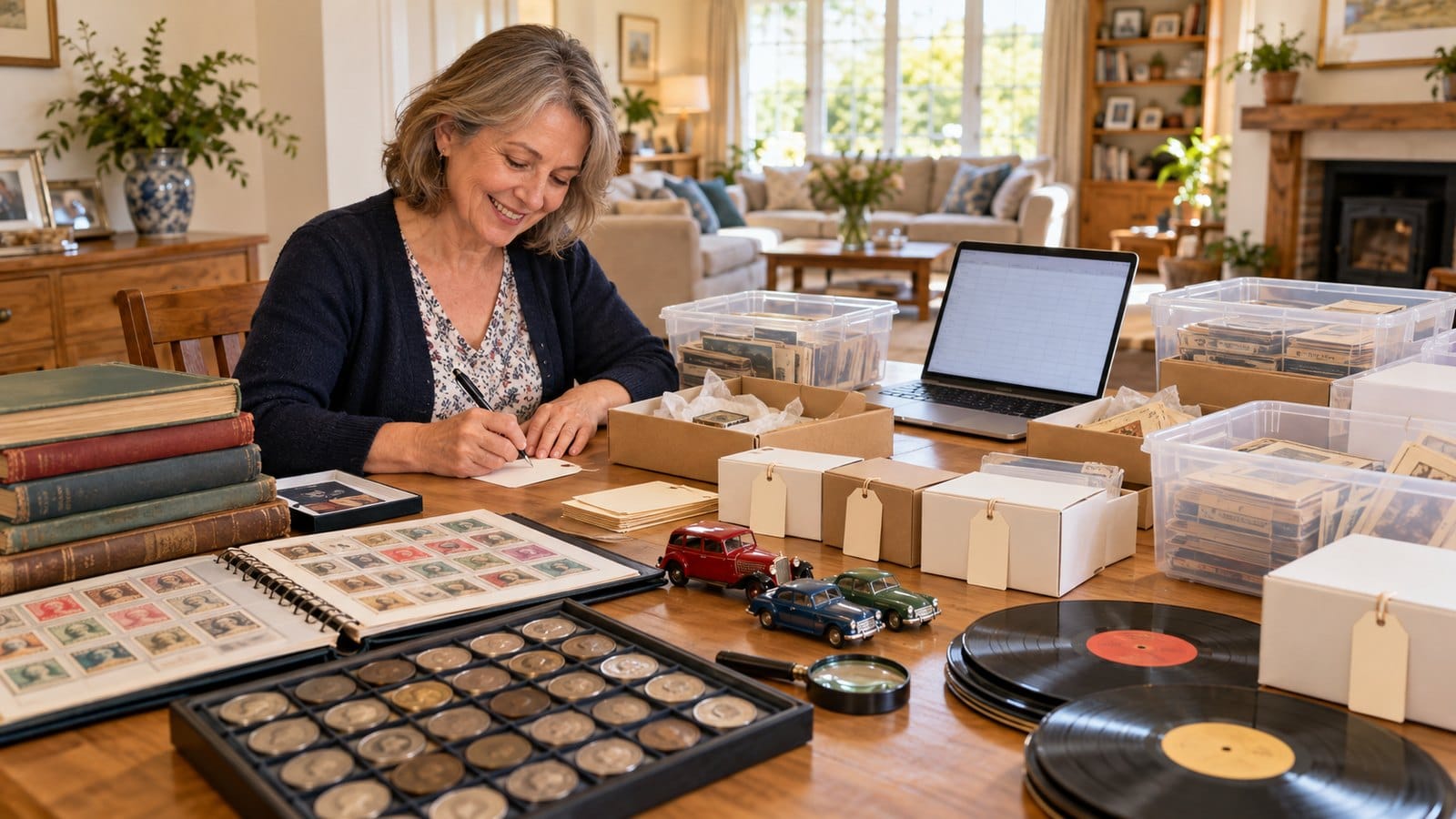
If you want to sell a collection online in the UK, start with three jobs. Decide what to sell and how, catalogue every item, and check your tax position. Listing comes after that.
This guide is for anyone with a large collection. It might hold 20 or 30 items, or many more. It might be your own, or one you inherited or were given. Coins, stamps, cards, records, books, toys, models and memorabilia all count. Some items, such as ivory and blades, have extra legal rules. See our guide to selling collectibles online.
Decide what to sell, and how
Sort the collection into three groups: keep, sell as single items, and sell as lots or sets. This is a practical split, not a legal rule.
Keep anything you would regret selling, and anything you cannot identify yet. If one item may be worth far more than the rest, get it valued before you list it.
Single items suit pieces with their own sold comparisons. A graded item with a certificate can suit a listing of its own.
Lots suit items that belong together or have little value alone. Duplicates are a common example.
Did you inherit the collection? Look for paperwork first. A will, an inventory and any valuation of the estate may matter for tax later. If several people share it, agree who sells what.
Catalogue first, list second
Build a catalogue before you list a single item. A spreadsheet is enough. Use one row for each item, with its own reference number.
These columns cover the basics:
- Reference number
- Description
- Condition
- Certificate or grading details, if any
- Photos taken (yes or no)
- Sold price evidence, such as saved links to similar sold items
- Price
- Status (unlisted, listed, sold or held back)
- What you paid and when you got it, if you know
Here is a hypothetical example row. Reference B-014. Hardback novel, first printing. Light wear to the spine. No certificate. Four photos taken. Three sold items saved. Price to be set. Status unlisted.
Write the reference on a label that stays with the item.
Listing in batches
Do not wait for the whole catalogue to be finished. Choose a first batch from one category. A small batch, such as ten items, is enough to start.
Copy the details from your catalogue into each listing. Use one pattern for every title, for example, item type, year or edition, condition and reference number. Use one order for every description.
Keep the reference number in each listing. When a buyer asks about an item, you can find its row in seconds. Update the status the moment something sells. This matters most if the same item is listed in more than one place.
Review the first batch before you start the second. Note the questions buyers ask. Answer them in your template.
Setting prices across a whole collection
Start from sold prices, as our guide to selling collectibles online explains. Then sort your items into bands by condition and by the evidence in your catalogue.
Here is a hypothetical set of bands. Band A has three or more close sold matches in the same condition. Band B has one or two matches. Band C has no match. Price Band A from the sold prices. Hold back Band C for a valuation, or put it into a lot.
Make the same deduction for the same flaw across the collection.
Choose a review date for each batch. Then look at items that have not sold. Check the photos and description first. Then compare the price with newer sold prices. Lower the price, move the item into a lot, or take it off sale.
Lots, sets and single items
A lot is one listing for several items. Give each lot its own reference and record in the catalogue which items it holds. Describe the contents, the condition of the group and any flaws. List a valuable item on its own instead of hiding it in a mixed lot.
Tax adds a rule for sets. HMRC's helpsheet HS293 defines a set as items that are similar and complementary to each other and worth more together than separately. Its examples are chessmen, books by the same author or on the same subject, and matching vases or statuettes.
The £6,000 limit for a single item applies to a set as a whole. Breaking up the set does not remove that rule. HMRC treats the parts as one set if you sell them to the same person, to people acting together or to connected people (HMRC Capital Gains Manual CG76631). The sales can take place on different days.
HMRC's Capital Gains Manual adds notes on whole collections. It says smaller sets may sit inside a collection that is not a set as a whole (CG76632).
- A stamp collection is not normally a set, even if every stamp is from one country. A full run of values from one commemorative or definitive issue of one country is a set (CG76883).
- A book collection is not normally a set. A large one may contain smaller sets, such as books by one author (CG76884).
- A coin collection is unlikely to be a set. A full range of values from one year or one reign would form a set (CG76881).
Tax on your collection sales
This is general information from GOV.UK and HMRC, not tax advice. If your position is unclear, ask HMRC or a tax adviser.
Capital Gains Tax is charged on your gain, which is your profit. HMRC calls collectibles personal possessions, and each item has its own £6,000 limit. The law and helpsheet HS293 treat a gain as exempt if the item sells for £6,000 or less. Some GOV.UK pages say tax may be due on items sold for £6,000 or more. If an item is close to the line, ask HMRC.
Between £6,000 and £15,000, a cap applies. Multiply the amount over £6,000 by five-thirds. Your gain is the lower of that figure and your actual gain. HMRC's example is an antique mirror sold for £7,500. The cap is £2,500 and the actual gain is £5,750, so the chargeable gain is £2,500.
Your gain is usually the sale price less what you paid. GOV.UK says you can also deduct costs for valuing or advertising.
Wasting assets have a predictable life of 50 years or less. HS293 says gains on them are exempt unless you claimed, or could have claimed, capital allowances. HMRC's manual treats antique clocks and watches as wasting assets, and mechanical models and toys too. It says most antiques, medals, stamps and books are not.
Inherited items have their own starting cost. If an Inheritance Tax value was set for the item, HMRC's helpsheet HS282 says to use it as your cost. GOV.UK says that if you do not know it, you use the market value on the date of death. The estate usually pays any Inheritance Tax. For gifts, GOV.UK says to use the market value on the date of the gift. A gift from a spouse or civil partner follows special rules.
You only pay on total gains above the annual exempt amount. For 2026 to 2027, it is £3,000 for individuals.
You do not get a bill. You work out your gains yourself. HS293 says you include a gain in your tax return only when the item sold for more than £6,000 and is not exempt. You can report in a Self Assessment tax return or use HMRC's real-time Capital Gains Tax service. With that service, you report by 31 December in the tax year after the gain and pay by 31 January. GOV.UK's example is a gain in 2025 to 2026: report by 31 December 2026 and pay by 31 January 2027. Keep your receipts, valuations and sale records for at least a year after the Self Assessment deadline.
Trading or clearing out?
HMRC also asks whether you are trading. GOV.UK says you are unlikely to pay tax if you sell personal items from your home, such as the contents of a loft or garage. Its attic example involves no item worth more than £6,000. It says you are unlikely to need to tell HMRC, no matter how many items you sell.
HMRC's Business Income Manual lists nine badges of trade. No single badge decides the question. For a long-held collection, some badges point away from trading. The manual says an asset held indefinitely, or acquired by gift or inheritance, is less likely to be the subject of a trade. Pointers towards trading include repeated transactions, a quick resale after buying and changes made to help a sale. The manual also says breaking assets into smaller lots to ease a sale may point to trading. Its example is bulk brandy. It is one pointer among several.
Buying more to resell can change the picture. GOV.UK says you are likely to be trading if you buy goods to sell at a profit. HMRC's manual says an intention to trade can form later, even for something you inherited.
The trading allowance is £1,000. GOV.UK says that if your total trading income is more than that for the tax year, you need to tell HMRC.
Business Companion, the Trading Standards guidance, says there is no set financial threshold for being in business. It lists selling in significant quantities and selling through several channels among the signs. No single sign decides.
Since 1 January 2024, platforms may collect seller details and report them to HMRC. Your details are not reported if you make fewer than 30 sales of goods in a calendar year and receive 2,000 euros (about £1,700) or less for them. A large collection can pass either limit. A report does not mean you owe tax.
Where MC999 fits
MC999 is a UK marketplace where shoppers can discover independent sellers. Sellers can add products manually or connect a Shopify, Shopline or BigCommerce shop; the How to Sell guide covers both. It is an additional way to be found, alongside the places you already sell.
Already selling through your own shop? See how to add your products to MC999 and give shoppers another way to find your business.
Frequently Asked Questions
Can I list in batches or do I need everything ready at once?
You can list in batches. Each item needs a finished row first. That means a description, its condition, photos and a price. Rows for later batches can stay unfinished while your first batch is live. Mark those items as unlisted until they are ready.
Can HMRC check the value I use for an inherited item?
Yes. HMRC can check your valuation after you sell. GOV.UK points to a post-transaction valuation check form, which you return to the address on the form. It says to allow at least three months for a reply. Keep a copy of any valuation you use.
Does anything change if one buyer takes the whole collection?
HMRC's manual says the price should be split between the items on a just and reasonable basis when a collection is sold together (CG76871). Its guidance to HMRC staff asks for a full description of what was sold. Your catalogue can supply that. The set rule above still applies to any sets inside the collection.
Sell on MC999
Ready to start selling without paying commission on every sale? Join MC999 as a Founding Seller and keep full control over your prices, delivery and returns.