How to Sell Diecast Model Cars Online in the UK
Identify each diecast model by maker, catalogue number and variation, grade the model and box separately on a published auction scale, disclose repaints, photograph base plates and box ends, price from sold auction results and know when a vintage model counts as a toy.
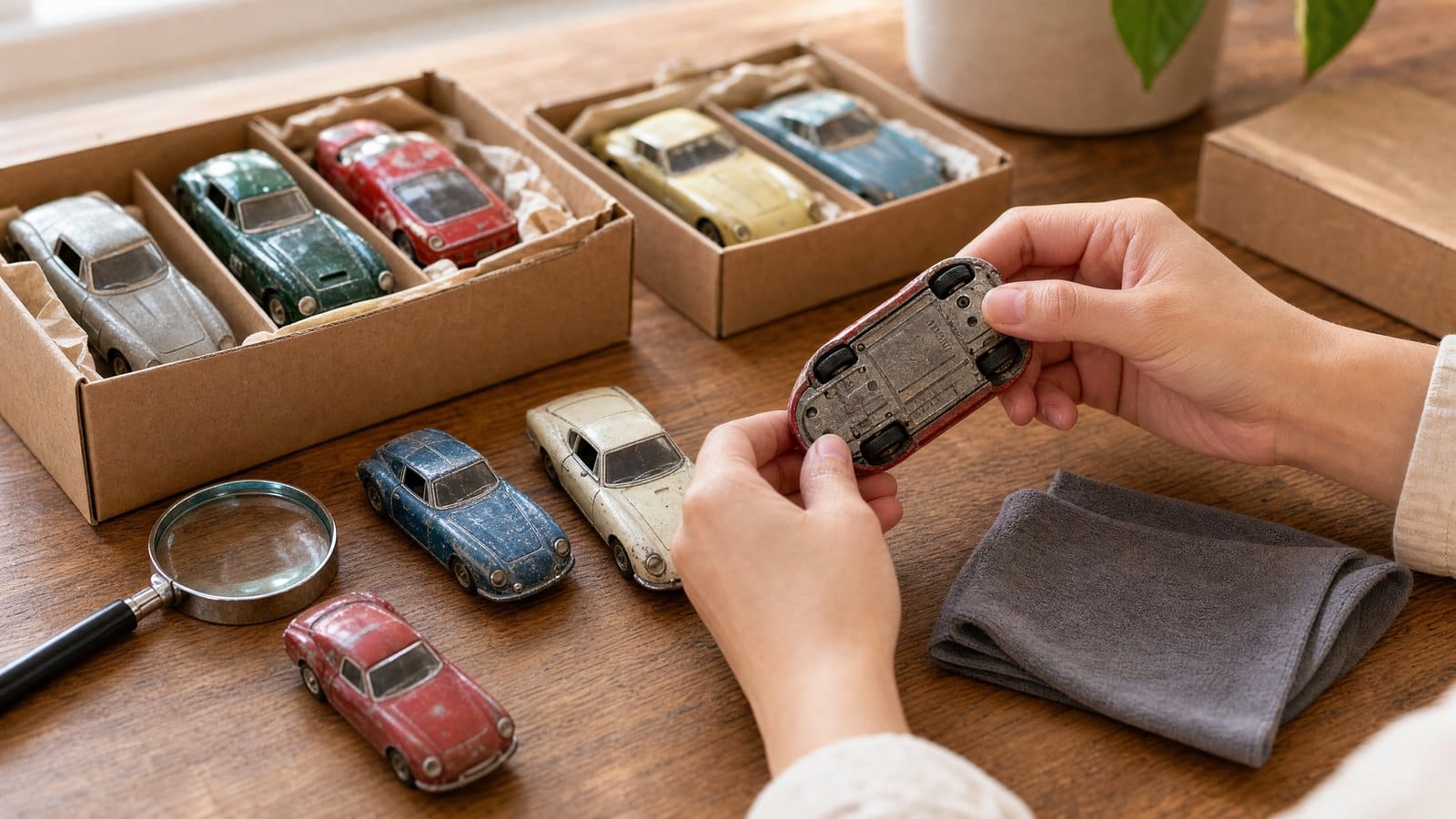
To sell diecast model cars online in the UK, identify each model by maker, catalogue number and variation, grade the model and its box separately on a published scale, and price it from sold auction results for the same variation in the same condition. Disclose every repaint or replacement part, photograph the base plate, wheels and box ends, and pack the model and the box as two fragile items. The steps apply to vintage Dinky, Corgi and Matchbox, to Hot Wheels, and to modern 1:18 and 1:43 collector models.
For consumer rights, trader status and tax in general, see our guide to selling collectibles online in the UK. For cataloguing and listing in batches, see selling a large collection online.
Step 1: Identify the maker, model and variation
Start with the base plate. It usually carries the maker's name and the model name, and often a catalogue number and the country of manufacture.
The country line helps with dating. Corgi's own history says production of Corgi Toys moved to China in 1990, so a Corgi base reading "Made in China" points to 1990 or later. Corgi also reissued the Goldfinger Aston Martin DB5 in 2021 in recreation packaging of the original, and the Corgi Model Club sells official re-issues of Corgi Toys. A period-style box does not prove age, so check the base.
Then separate the casting from the variation. The casting is the model itself; the variation is what changed during its run: colour, wheels, interior, labels or printed decoration, and the box. Corgi's history dates its first plastic interior to 1962, its Whizzwheels to 1970 and the move from labels to pad printing to the 1980s, so these details help date a model.
Small differences decide the price. In October 2026 Vectis Auctions sold a Dinky Toys No. 156 Rover 75, a rare issue in two-tone violet blue and cream with ridged hubs, in its picture box with the correct colour spot, for £686 including buyer's premium. "Dinky Rover, blue" would hide every detail a collector searches for.
Confirm the variation against a printed collectors' catalogue for the maker and against auction descriptions of the same catalogue number. Then build the title in a fixed order: maker, catalogue number, model, livery, scale, boxed or unboxed. For example: "Corgi Vanguards VA09001 Rover SD1 Metropolitan Police, 1:43, boxed".
Step 2: State the scale and the length
Scale is a ratio: a 1:43 model is one forty-third the size of the real vehicle. A car 4.3 metres long becomes about 10 cm at 1:43, about 24 cm at 1:18 and about 6.7 cm at 1:64.
Mattel says most Hot Wheels cars and most Matchbox cars are 1:64. Corgi makes its Vanguards cars at 1:43, and its history gives the Original Omnibus Company buses as 1:76. If the scale is not marked, do not guess. Give the measured length in centimetres either way.
Step 3: Grade the model and the box separately
Use a published scale and name it in the listing. Vectis Auctions, a UK toy auction house, uses this one:
- Mint: perfect condition.
- Near Mint: almost perfect, only extremely minor imperfections.
- Excellent: very careful use, small imperfections.
- Good: more use, obvious imperfections.
- Fair: heavy wear, major imperfections, may include repaints.
- Poor: very distressed, many faults.
"Plus" marks an item better than its grade suggests, and the grade covers appearance only. Vectis grades contents and packaging separately: one Vanguards police group was Good to Near Mint in generally Good cases. Write yours the same way, for example "model Near Mint, box Good Plus".
On the model, check paint chips (how many and where), wear on edges and high points, scratched windows, bent axles, missing aerials, figures or accessories, and lifting or missing labels. On the box, check end flaps, tears, crushing, fading, writing, price stickers and tape, and whether the inner card, stand or leaflet is present. Inner packaging counts: a Dinky No. 917 "Munsterland" promotional issue sold at Vectis for £1,164 including buyer's premium, and its description listed the inner pictorial stand alongside the original box.
Why the original box matters
Corgi says some of its models in mint condition and complete with box, which sold for a few shillings, now fetch hundreds of pounds. The box must also be the right one: the Vectis Rover description noted the correct colour spot, so expect collectors to check that box and model match.
Say so if a box is a reproduction, belongs to another variation or was paired with the model later. If there is no box, put "unboxed" in the title.
Step 4: Disclose restorations and repaints
Vectis puts repaints into its Fair grade. Name every change you know about or can see: repainted body or touched-in chips, replacement wheels, tyres or axles, reproduction labels, a base that has been removed and refitted, replacement parts, and a reproduction box or inner card.
A trader's goods must match their description under section 11 of the Consumer Rights Act 2015, and a private sale by description carries a similar implied term under section 13 of the Sale of Goods Act 1979. For traders, section 226 of the Digital Markets, Competition and Consumers Act 2024 treats misleading information, including true information presented in a misleading way, as a misleading action. "Original paint" on a model with touched-in chips is that kind of statement.
Clear wording looks like this: "Repainted in the original colour, wheels replaced, base refitted. Sold as a restored example."
Step 5: Photograph the base, wheels and box ends
- both sides, the front, the rear and the roof
- the base plate, close enough to read every word
- a wheel close-up showing the hub and tyre type
- the interior, through the windows
- each box end, and any colour spot or printed number
- every face of the box, the inner packaging and any leaflet
- each chip, tear or repair, with a ruler beside the model
If a modern model's box carries an age statement, photograph that too.
Step 6: Price from sold auction results
Use auction results, not asking prices. The Vectis Dinky department page shows hammer prices for past lots, such as £3,200 for a post-war Dinky No. 1 "Commercial Vehicles" Gift Set sold on 5 November 2019. On individual lot pages you log in to see hammer prices.
Check which price you are reading. Vectis lot pages say price realised is the hammer price plus fees of 22.5% plus VAT, and its news stories quote prices including buyer's premium. At the standard VAT rate of 20%, a £100 hammer price costs the buyer £127. Note both figures so you compare like with like.
Then match the variation, the model grade and the box grade. A Near Mint model in a Good Plus box is not evidence for an Excellent model with no box. With no exact match, price from the nearest results and adjust for the differences you can name.
Step 7: Decide between lots and singles
List a model on its own when it is an identified variation, boxed and Excellent or better, a complete gift set, or a model with strong sold results of its own. Keep each model with its own box and inner packaging, and never split a gift set from its box.
Lots suit unboxed playworn models, duplicates and common modern releases. Describe them as an auction house does: the Vectis Vanguards group named the catalogue numbers of its main models, gave a condition range and said it had not been checked for completeness. For cataloguing a whole collection and how tax treats sets, see our large collection guide.
Step 8: Pack the model and the box as two fragile items
The Post Office packing guide recommends a double- or triple-walled corrugated box for fragile items, contents centred 5 cm clear of the walls and corners, fragile items not touching each other or the sides, and every edge sealed with 4 to 5 cm nylon or vinyl tape. For diecast:
- Check the model is still fixed to any plinth. If it is loose, wrap it separately and say so in the listing.
- Put the collector box in a plastic bag or tissue, so bubble wrap and tape never touch the card.
- Wrap the boxed model in bubble wrap and centre it in the outer box.
- In a lot, wrap each model on its own so none can chip another.
Read the carrier's cover terms first. Evri, for example, says its free £20 cover excludes some items such as antiques.
Collector's item or toy: the safety note
The Toys (Safety) Regulations 2011 define toys as products designed or intended, whether or not exclusively, for use in play by children under 14. Schedule 1 says products for collectors are not toys if the product or its packaging bears a visible and legible indication that it is intended for collectors aged 14 and above. Its examples include detailed and faithful scale models and historical replicas of toys.
Modern ranges differ. Mattel says all Matchbox die-cast vehicles are designed for children aged 3 and over, while Hot Wheels Red Line Club die-casts are designed for adult collectors. Read the age statement on the box and show it in your photos.
Vintage Dinky, Corgi and Matchbox models were made as toys. Business Companion, the Trading Standards guidance, says second-hand toys fall under the General Product Safety Regulations 2005 rather than the Toys Regulations, and must still be safe. GOV.UK guidance says a regular seller on an online marketplace is likely to be acting in the course of a commercial activity, while a parent posting used toys occasionally on social media is unlikely to be.
In practice, list vintage diecast as a collector's item, not suitable for young children, and do not offer broken models with sharp metal or loose small parts as playthings. These are the Great Britain rules; Northern Ireland has its own versions.
Listing diecast models on MC999
MC999 is a UK online marketplace with no commission on sales; sellers pay a monthly fee based on the scale of their business. With a Shopify, BigCommerce or Shopline store, you connect it and buyers complete the purchase on your own website. Without a web shop, you list items manually and arrange payment with the buyer directly. The first 300 approved UK Founding Sellers get the monthly fee free for 6 months; see the Founding Seller page.
FAQ
Should I take a boxed model out to photograph it?
Yes, if it comes out without forcing the end flaps, because buyers want to see the base and wheels. If it is fixed into a display case or the box is fragile, photograph it through the window and say you did not remove it.
Can I describe a reissue as vintage?
No. Say it is a reissue, give the year if you know it, and show the base. Corgi has reissued the Goldfinger DB5 in recreation packaging of the original, so collectors check the base before they buy.
Does Mint mean the model has never been out of its box?
Not on the Vectis scale. Mint means perfect condition, and the grade describes appearance. If a model has never been removed from its packaging, state that separately as a fact.
Sources (checked 2 November 2026)
- Corgi history: production moved to China in 1990, plastic interiors 1962, Whizzwheels 1970, pad printing in the 1980s, Original Omnibus 1:76, DB5 reissue in recreation packaging 2021
- Corgi: mint models complete with box that sold for a few shillings now fetch hundreds of pounds
- Corgi Vanguards range of 1:43 scale model cars
- Corgi Model Club: official diecast metal re-issues of Corgi Toys
- Mattel: most Hot Wheels cars are 1:64; Red Line Club die-casts designed for adult collectors
- Mattel: most Matchbox cars are 1:64; all Matchbox die-cast vehicles designed for children aged 3+
- Vectis grading system: Mint, Near Mint, Excellent, Good, Fair (may include repaints), Poor, Plus; appearance only
- Vectis lot: Vanguards group graded Good to Near Mint in generally Good cases, not checked for completeness; price realised is hammer plus 22.5% plus VAT; login to see hammer prices
- Vectis: Dinky No. 156 Rover 75 rare issue with ridged hubs and correct colour spot box, £686 including buyer's premium
- Vectis: Dinky No. 917 Munsterland promotional issue with inner pictorial stand and original box, £1,164 including buyer's premium
- Vectis Dinky department: hammer price £3,200 for post-war No. 1 Commercial Vehicles Gift Set, 5 November 2019
- GOV.UK: standard VAT rate 20%
- Consumer Rights Act 2015, section 11: goods to be as described
- Sale of Goods Act 1979, section 13: sale by description
- Digital Markets, Competition and Consumers Act 2024, section 226: misleading actions
- Toys (Safety) Regulations 2011, regulation 4: toys are products for play by children under 14; separate Northern Ireland version
- Toys (Safety) Regulations 2011, Schedule 1 paragraph 3: products for collectors marked 14 and above are not toys
- OPSS guidance (GB): scope, Schedule 1, second-hand toys and commercial activity online
- Business Companion: second-hand toys covered by the General Product Safety Regulations 2005 and must be safe
- Post Office: double or triple walled boxes for fragile items, 5 cm from walls, items not touching, 4 to 5 cm nylon or vinyl tape
- Evri: £20 free cover excludes some items such as antiques