How to Sell Jewellery Online in the UK
What you can call gold or silver, when a piece needs a hallmark, how to show hallmark information online, and how to photograph, measure and handle returns for made-to-order pieces.
If you are selling jewellery online in the UK, check how you describe the metal. If you describe jewellery as gold, silver, platinum or palladium, it must be hallmarked unless it weighs less than the exemption weight for that metal. If you are selling online, you must display information explaining hallmarks. Then your listing needs to tell the buyer exactly what they will be receiving and your terms need to address made to order and engraved items.
Below are the exemption weights, the exact wording for plated pieces and what to show buyers.
When you need a hallmark for a piece
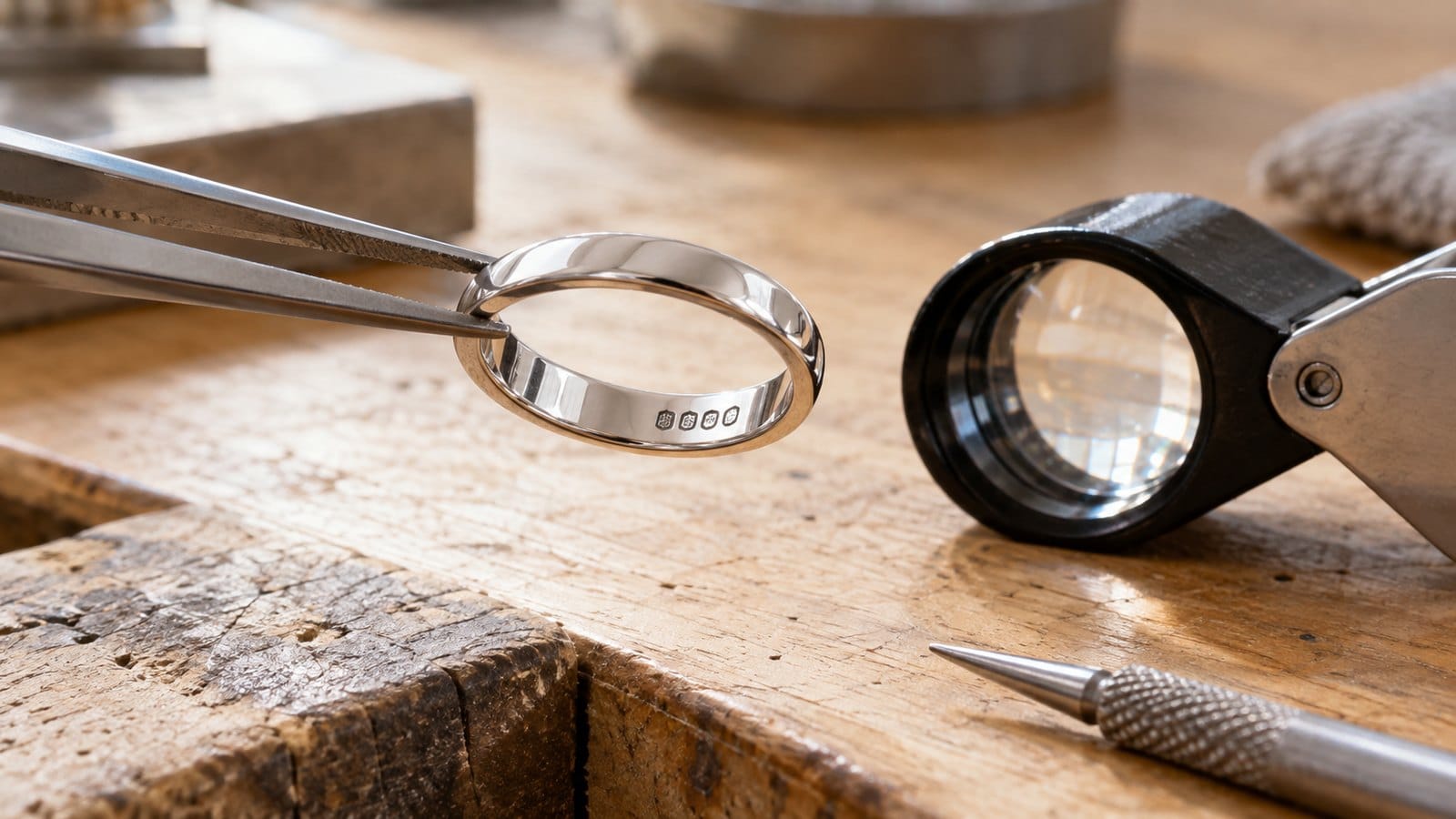
The hallmark certifies the metal and its purity. GOV.UK's hallmarking guidance says that if a piece of jewellery is described as gold, silver, platinum or palladium, it must be hallmarked, with minimum weight exemptions depending on the metal (GOV.UK: hallmarking in the UK). The exemptions are determined by the total weight of precious metal in the item by the Hallmarking Act 1973 (Hallmarking Act 1973, Schedule 1).
- Gold: exempt under 1 g. Common standard marks: 375 (9ct), 585 (14ct), 750 (18ct).
- Silver: exempt under 7.78 g. Common marks: 925 (sterling), 958, 999.
- Platinum: exempt under 0.5 g. Common marks: 950, 999.
- Palladium: exempt under 1 g. Common finenesses: 500, 950, 999.
The standard marks are listed in Schedule 2 of the Act. That number is in parts per thousand, so 375 means that there are 375 parts of gold in every 1,000 parts.
Hypothetical example: a silver pendant weighing 5.2 g falls under the 7.78 g limit, so it can be sold as silver without a hallmark. A 9 g silver bangle is over the limit, so it needs a hallmark before you can describe it as silver.
The exemptions do not apply in the same way to items that mix precious metals, or are made of precious metal and other materials. If an item has a gold detail on a silver base or a silver setting with a non-metal insert, check with an Assay Office before listing it.
Correctly describe plated and coloured pieces
Words such as "gold" and "silver" are only allowed on base metal pieces with the proper qualifier. The Act permits "gold" qualified by "plated" or "rolled", and "silver", "platinum" and "palladium" qualified by "plated". In a written description, the word "plated" or "rolled" must be at least as large as any other lettering in it (Hallmarking Act 1973, Schedule 1, Part I). A description which is confined to colour is also permissible.
- If it is brass and gold plated, you would write "Gold plated brass hoop earrings" and not "Gold hoop earrings".
- If it is a plated chain, write "Silver plated chain", not "Silver chain".
- Leave every word of the title in the same size of lettering, so "plated" is never in small print.
If you don't know what something is made of, ask your supplier before you list it, and describe only what you can confirm.
Show hallmark information on your shop
Dealers supplying articles of precious metal must display a notice explaining the approved hallmarks under the Hallmarking Act. Online retail sites must also prominently display explanatory information about the hallmark, either as Dealer's Notice A or Dealer's Notice B, which is a PDF or a short film for sites where a dedicated page is not required (GOV.UK: hallmarking, how businesses can comply with the law). The notices are from the Assay Offices.
Linking a page from the footer and from each precious metal listing on your own shop is an easy way to make it prominent.
Take pictures of each item so buyers know what they are buying
- Shoot in daylight or under a daylight lamp, on a plain background, without heavy filters, so the colour of the metal is true.
- Add close-ups of the clasp, setting and hallmark.
- Include one photo for scale: on a hand, on a neck form or next to a ruler.
- Maintain consistent lighting across listings so that 9 carat yellow gold appears the same from one item to the next.
- For sets and gift boxes, show what you get exactly.
Write descriptions with measurements
State the metal and its fineness, the weight in grams, and the measurements that count for the piece:
- Chains and necklaces: length in cm and the width of the chain.
- Pendants and earrings: height and width, and drop for earrings.
- Rings: the UK letter size and whether you offer resizing.
- Bracelets and bangles: inner diameter or circumference.
Name stones accurately and say whether they are natural, lab-grown or simulants. If you don't know, say so rather than guess. For handmade pieces, say that small variations between pieces are normal.
Made-to-order items, returns and company details
Online buyers have 14 days to cancel after receiving their item, then a further 14 days to return it, and you must refund within 14 days of receipt (GOV.UK: accepting returns and giving refunds). Goods made to the buyer's specifications or clearly personalised, such as an engraved ring, are excluded from that right to cancel (Consumer Contracts Regulations 2013, regulation 28). For these, you only need to give a refund if they are faulty.
A ring available from stock in a standard size is subject to the normal 14-day rule. A ring engraved with the buyer's initials is clearly personalised. State which of the two applies in each listing, before the buyer pays.
Specify the time needed if a piece is made to order. You must also provide your business name, contact details and address, the price including all taxes, and the delivery arrangements, costs and time before an order is placed (GOV.UK: online and distance selling). For valuable pieces, choose a tracked delivery service, and check the compensation limit of that service before you post.
Where MC999 fits
Good photos and accurate descriptions of the metal help shoppers decide if a piece is right for them. You can also list your jewellery on MC999, a UK marketplace where shoppers discover products and the independent shops behind them. If your shop is on Shopify, Shopline or BigCommerce, you can link it up. Shoppers who find a piece on MC999 will be directed to your shop to buy. You can also manually add products, and the How to Sell guide explains both ways.
Shoppers can browse rings, necklaces, bracelets and watches from independent UK sellers in the jewellery and watches category.
Already selling through your own shop? See how to add your products to MC999 and give shoppers another way to find your business.
Pre-listing checklist
- The metal and fineness are given, and the piece is hallmarked if it is over the exemption weight.
- Plated pieces read "plated" in type as large as the rest of the title.
- Dealer's Notice information is clearly displayed in your shop.
- Photos showing true colour, the clasp, the setting, hallmark and scale.
- Weight and measurements. Rings are sized in UK letter sizes.
- The lead time for made-to-order items and the returns policy for bespoke pieces are displayed before the buyer pays.
- Your business name, address and delivery costs are easily found.
Related guides: How to Photograph Jewellery for Online Listings, Hallmarking Rules for Selling Jewellery Online in the UK, and Earrings and Nickel: UK Rules for Jewellery Sellers.
Frequently Asked Questions
Do I need a hallmark if I only sell a few pieces?
The rules on hallmarking are based on the description of the piece and its weight, not on the number you sell. If you call a piece silver, then it needs a hallmark if it has 7.78 g or more of silver. You can apply for a sponsor's mark and submit articles for hallmarking through any of the UK Assay Offices.
Can an engraved or made-to-order piece be returned by a buyer?
You only have to accept a return if the item is faulty, as the 14-day right to cancel doesn't apply to goods that are made to the buyer's specifications or are clearly personalised. Please mention this in the listing before the buyer orders.
Sell on MC999
Ready to start selling without paying commission on every sale? Join MC999 as a Founding Seller and keep full control over your prices, delivery and returns.