How to Sell Reptile Supplies Online in the UK
A practical guide to selling reptile kit in the UK: describe and check used vivariums, pair heat mats and ceramic heaters with the right thermostat, price UVB lamps by their rated life, post live insects under Royal Mail rules, and know when a licence or Article 10 certificate applies.
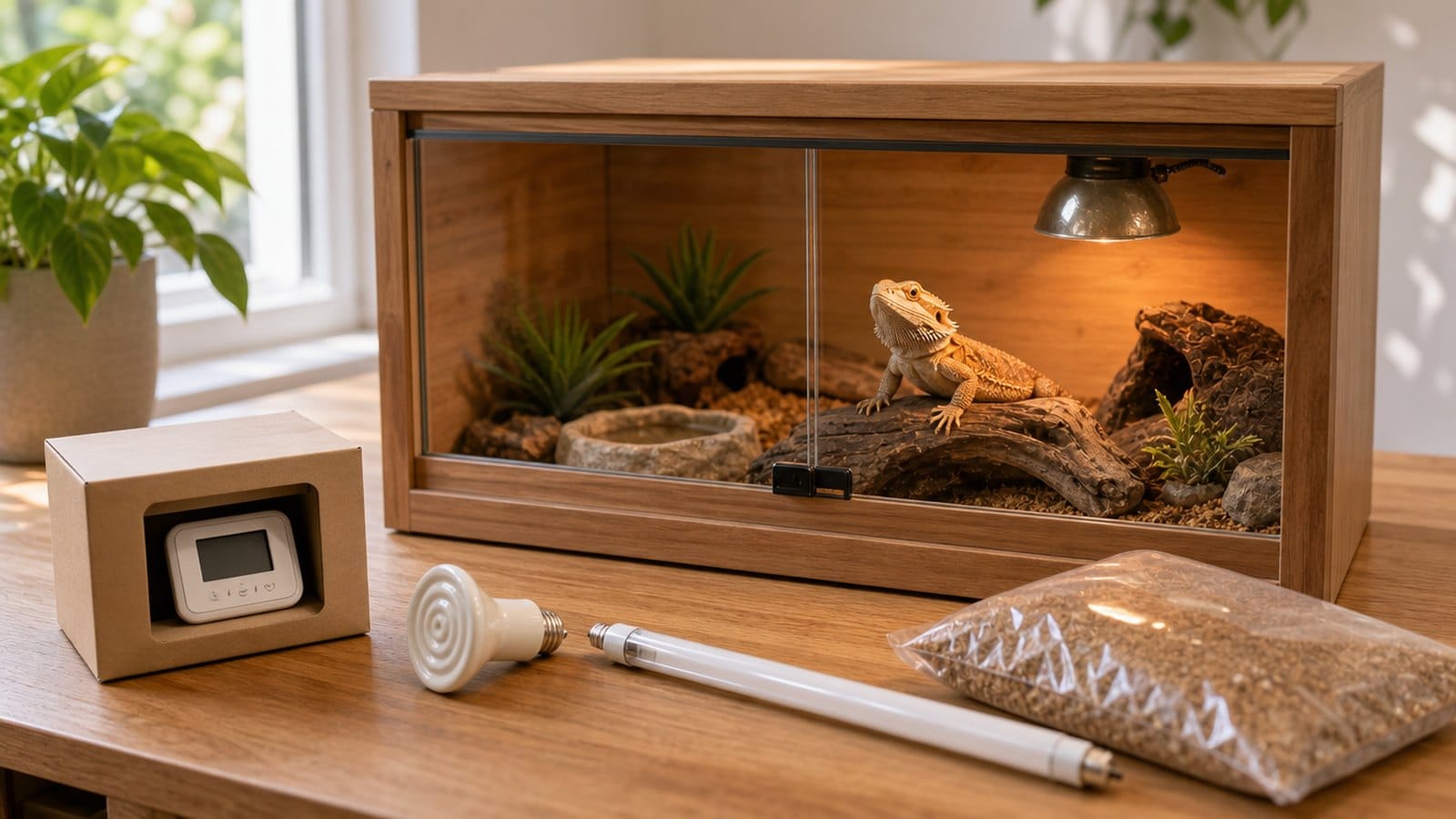
To sell reptile supplies online in the UK, describe each item by size, wattage and age, and decide early what can be posted. Most vivariums end up collection only; heaters should be listed with the thermostat they need, and UVB lamps sell on their remaining rated life. Live insects can go by Royal Mail within the UK under set conditions; live reptiles cannot be posted at all, and selling reptiles as a business in England needs a council licence. For pet food, accessory safety, returns and tax, see the guide to selling pet products online. Tanks, filters and aquatic kit are in the guide to selling aquarium supplies.
What buyers check in a reptile listing
Keepers buy for a particular animal and enclosure, so give the numbers they will compare with their setup:
- Vivariums: outside length, depth and height in centimetres, material (glass, wood or PVC), door type, and whether it is flat-packed.
- Heat mats: wattage, size, and whether the mat is stuck to a vivarium.
- Ceramic heaters and heat bulbs: wattage, cap type (for example, E27), and the holder or guard included.
- Thermostats: type (on/off, dimming or pulse proportional) and maximum load in watts.
- UVB lamps: brand, UVB percentage, length or cap, and the date the lamp was first switched on.
- Substrates: product name, bag volume in litres or weight in kilograms, and whether the bag is sealed.
- Decor: material and measurements.
A hypothetical title that answers those questions: "Exo Terra Heat Mat 16 W, 26.5 x 28 cm, fitted to 60 cm glass terrarium, collection only".
Vivariums: glass or wood, collection or courier
Size and fragility decide this:
- Royal Mail Tracked 48 takes medium parcels up to 20 kg and 61 x 46 x 46 cm, with compensation up to £75. A small boxed terrarium may fit; most vivariums will not.
- Parcelforce lists items wholly or partly made of glass among goods excluded from damage compensation. It also excludes furniture, flat-packed or ready-built. A glass vivarium has no damage cover there, and a wooden one may be treated as furniture, so ask before you rely on cover.
Before you list a used vivarium:
- Empty and clean it, and say what you cleaned it with.
- Check glass for chips and cracks, and sliding doors and locks for smooth running and keys.
- On wood, check the base and corners for swelling or damp.
- Check mesh and vents for tears or gaps, where escapes start.
- For collection, give the town, the assembled size, and whether two people are needed.
Confirm the money is in your account before handover; the guide to avoiding scams and fake buyers explains fake payment notifications.
Heat mats, ceramic heaters and thermostats
Habistat says its heat mats should always be used with an appropriate thermostat, and its ceramic heat bulb holder carries the same instruction. Its carbon-printed mats add a built-in thermal cut-out on top of a thermostat, not instead of one. Habistat advises testing installed heating for at least 48 hours before animals go in. The Exo Terra heat mat manual says an under-tank mat needs substrate on top to prevent burns, and that keepers should check the temperature with a thermometer. For a seller:
- Match heater and thermostat. The Habistat Mat Stat is an on/off thermostat for heat mats and low-powered heaters up to 300 W; Habistat says it is not suitable for light bulbs, which need a dimming thermostat. Name the thermostat type, or say the buyer will need one.
- Add up bundle wattage. Total the heaters sold on one thermostat and compare with its maximum load.
- Check whether the mat is stuck down. Exo Terra says its mat permanently adheres to the terrarium and should not be removed, so sell an attached mat with the vivarium.
- Check the cord. The same manual says the cord cannot be replaced and a mat with a damaged cord should be discarded, so do not sell one.
- Name the right holder. The Exo Terra ceramic heater manual says the heater must only be used with Exo Terra Wire Light fixtures, warns of a possible fire hazard otherwise, and says to let it cool for 30 minutes before removing it. List the holder your heater's maker specifies.
- Say if a guard is included. The Exo Terra Heat Guard manual says a guard stops the reptile touching the heater and reduces the risk of thermal burns.
UVB lamps: the fitting date sets the value
Makers give each UVB lamp a working life. Arcadia says its D3+ Desert and D3 Forest T8 lamps have a 12-month lifespan before a change is required, and that its UVB percentages are measured after the first 100 hours of use. Zoo Med says its PowerSun UV should be replaced once a year. Check the figure for your exact lamp.
- Give the month the lamp was first used, and the hours per day if you know them.
- If it is past the maker's replacement interval, list it as past its rated life, not as a working UVB lamp.
- Offer reflectors, controllers and fittings separately too, for buyers who only need the fitting.
Royal Mail Tracked 48 takes tubes up to 2 kg and under 90 cm, where the length plus twice the diameter is under 104 cm; longer tubes go as parcels. Parcelforce excludes fluorescent tubes and light bulbs from damage compensation, so use a rigid box padded at both ends.
Substrates and decor
- Substrate: sell sealed original bags with the product name and volume; used substrate belongs in the bin.
- Weight: weigh bags before quoting postage, as sand or soil soon passes the 20 kg medium parcel limit.
- Decor: give material and size, say how it was cleaned, and check resin for cracks and wood or cork for mould.
- Cover: Parcelforce also excludes resin items and rock, stone and mineral items from damage compensation, so pack resin hides, backgrounds and slate as carefully as glass.
Used electrical kit: a short safety check
If you sell second-hand electrical goods as a business, Business Companion, the Trading Standards guidance site, says they fall under the General Product Safety Regulations 2005 and need an approved BS 1363 plug with sleeved pins and the correct fuse; repairing an item makes you its producer. The aquarium guide has the full check. For reptile kit, add:
- Test each thermostat with its heater against a separate thermometer: on an on/off model, the heater should switch off once the set temperature is reached.
- Search each model on GOV.UK's product safety alerts and recalls.
Live food: posting insects
Royal Mail's prohibited and restricted items list allows live creatures, insects and invertebrates within the UK, with conditions:
- The list names crickets, cockroaches, mealworms, maggots, silkworms, spiders and stick insects, among others.
- No international sending, and since 1 May 2025, none from Great Britain to Northern Ireland. 1st Class is the minimum service.
- Mark the parcel "URGENT - LIVING CREATURES - HANDLE WITH CARE" and show your name and address on the outside.
- Containers must be escape-proof and ventilated, the outer packaging crush-proof, and water-resistant if the insects need moisture.
- Returns can only use Royal Mail Tracked Returns or Special Delivery Guaranteed Returns.
- Anything classed as dangerous under the Dangerous Wild Animals Act 1976, including certain venomous spiders, is not allowed.
State dispatch days so tubs do not sit in a depot over a weekend. Frozen feeder rodents cannot go by Royal Mail: the same list prohibits frozen or fresh pet food. The pet products guide covers the APHA rules for making raw pet food.
Live reptiles: licence first
- Post: Royal Mail does not carry live animals and reptiles, including snakes, mice and rodents, to any UK or international address.
- Licence: in England, a business that sells animals as pets needs a licence from the local council, even from home or online. A small number of offspring from your own pets sold as a hobby needs none, but selling often or in numbers may make you a business; the business test asks whether you sell with a view to profit or earn a commission or fee. Trading without a licence can mean up to 6 months in prison or an unlimited fine. Outside England, ask your council.
- Adverts: a licence holder's advert must show the licence number, the issuing council, a recognisable photo, the animal's age, and its countries of residence and origin. Equipment sold with an animal must suit it, and non-mammals that cannot feed themselves must not be sold (Schedule 3).
- Under 16s: selling an animal to someone you have reasonable cause to believe is under 16 is an offence (Animal Welfare Act 2006, section 11). Reptiles are vertebrates, so they are covered (section 1).
- CITES: an Annex A species needs an Article 10 certificate before you offer it for sale, keep it for sale or breed from it to sell the young; this covers dead specimens and parts, such as a shell. Annex B species need no certificate, but you must be able to show lawful origin. Check each species on Species+: the penalty is up to 5 years in prison or an unlimited fine.
Photos and pricing
Photograph:
- the vivarium from the front, doors closed and open;
- every chip, scratch, swollen panel or torn vent;
- the rating label on each heater, mat and thermostat;
- the thermostat beside a thermometer during your test;
- the model and UVB percentage printed on each lamp;
- substrate labels, and decor next to a ruler.
Price from sold listings for the same model, not asking prices. For a full setup, compare the sold prices of its parts with sold prices for similar complete setups. Compare a collection-only vivarium with sold listings nearby. Price a lamp past its rated life as a spare, and price its fitting separately.
Listing reptile supplies on MC999
MC999 is a UK online marketplace with no commission on sales; sellers pay a monthly fee, and the first 300 eligible UK sellers get six months with no monthly fee. If you run a Shopify, BigCommerce or Shopline store, you connect it, and buyers complete the purchase on your own website. Without a web shop, you can list items manually and arrange payment with the buyer directly. The Founding Seller page has the details.
FAQ
Can I sell a vivarium with the heat mat still attached?
Yes: list the mat as part of the vivarium, with its wattage, size and whether a thermostat comes with it. Exo Terra says its mats should not be removed once fitted, so do not peel one off to sell separately.
Can I post locusts?
Royal Mail's list of live creatures starts with "including" and names crickets and mealworms, but not locusts. Ask Royal Mail to confirm before you post them regularly, then follow the same 1st Class, marking and packaging rules.
Do I need a licence to sell the young my lizards produced?
GOV.UK says selling a small number of offspring from your own pets as a hobby does not need a licence in England, but regular or large-scale selling may. The under-16 rule applies whether or not you are a business.
Sources (checked 2 November 2026)
- Royal Mail: Tracked 48
- Parcelforce: Items we exclude from compensation
- Habistat: Carbon cloth heat mat
- Habistat: Carbon printed heat mat
- Habistat: Ceramic heat bulb holder
- Habistat: Mat Stat thermostat
- Exo Terra: Heat Mat operating instructions
- Exo Terra: Ceramic Heater operating instructions
- Exo Terra: Heat Guard operating instructions
- Arcadia Reptile: D3+ Desert lamp
- Arcadia Reptile: D3 Forest lamp
- Zoo Med: PowerSun UV
- Business Companion: Second-hand electrical goods
- GOV.UK: Product safety alerts, reports and recalls
- Royal Mail: Prohibited and restricted items
- GOV.UK: Selling animals as pets licence (England)
- Animal Welfare (Licensing of Activities Involving Animals) (England) Regulations 2018, Schedule 1
- Animal Welfare (Licensing of Activities Involving Animals) (England) Regulations 2018, Schedule 3
- Animal Welfare Act 2006, section 1
- Animal Welfare Act 2006, section 11
- GOV.UK: Commercial use of endangered species (Article 10)
- Species+