How to Sell Aquarium Supplies Online in the UK
A practical guide to selling fishkeeping kit in the UK: leak test and describe used tanks, check heaters and filters, know which treatments and CO2 cannot be posted, avoid banned aquatic plants, and learn when plant passports and a council licence for selling fish apply.
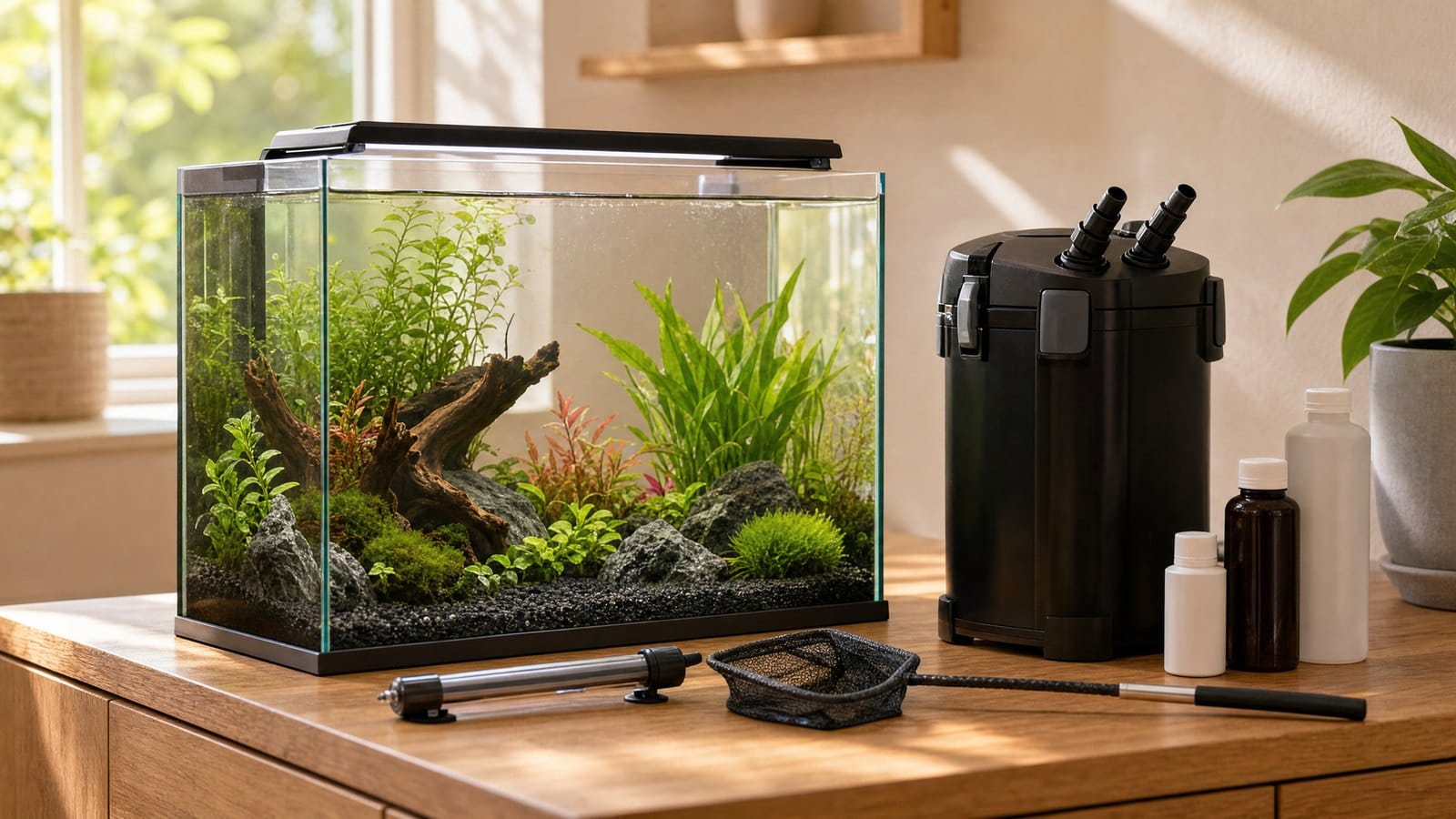
To sell aquarium supplies online in the UK, test and describe each item, then check the regulated parts. Used heaters and filters must be electrically safe; many water treatments and all CO2 cylinders cannot go in the post; some aquatic plants are banned from sale; plants sold online need a plant passport; and selling fish as a business in England needs a council licence. Most glass tanks end up collection only. For pet food, accessories, returns and tax, see the guide to selling pet products online.
What sells and what buyers need to know
Give the details buyers filter on:
- Tanks and complete setups: outside dimensions in centimetres, volume in litres, brand and model, and what is included.
- Filters: type (internal, external canister or hang-on), the tank size the maker rates it for, flow rate from the label, and which media and spares come with it.
- Heaters: wattage, length, and whether it is preset or adjustable.
- Lighting: length, mounting type and whether it is sold for freshwater or marine tanks.
- Decor, rock and substrate: weight, type, and whether it came from a freshwater or marine tank.
- Treatments, test kits and medicines: exact product name, volume, how full, and the expiry date.
Before splitting a setup, compare the sold prices of its parts with sold prices for similar complete setups. A full setup suits a beginner who can collect; a separate filter or light can be posted to buyers anywhere in the UK.
Check a used tank before you list it
- Drain it, remove the substrate and only move it empty.
- Inspect every silicone seam with a torch. Note and photograph gaps, peeling, bubbles or any lifted bead.
- Check the edges for chips and the panels for scratches, and say exactly where each one is.
- Leak test on a waterproof surface such as a patio or garage floor. Loctite's resealing guide fills a tank 3 inches (about 7.5 cm) at a time and runs kitchen paper along the seams: any moisture on the paper means the seam needs repair.
- Leave it full and state how long it held water with the paper dry.
- If you resealed it, say how. Loctite notes that new sealant does not always bond well to old, which is why it removes the old bead rather than patching over it.
Collection or courier for glass
Size limits and compensation rules make most tanks collection only:
- Royal Mail Tracked 48 takes medium parcels up to 20 kg and 61 x 46 x 46 cm, with compensation up to £75. A boxed nano tank may fit; most larger tanks will not.
- Parcelforce lists glass items among goods excluded from damage compensation, including damage that broken glass causes to other items in the parcel. Rock, stone and mineral items are excluded too, which covers aquascaping rock.
For collection, give the town, say whether the buyer needs a second person and a large vehicle, and confirm payment has reached your account before handover. The guide to avoiding scams and fake buyers explains fake payment notifications.
Heaters, filters, lights and pumps
If you sell second-hand electrical goods as a business, Business Companion, the Trading Standards guidance site, says they must meet the General Product Safety Regulations 2005, and you may owe compensation if an unsafe item causes injury or damage. For aquarium kit:
- Plug: appliances must be fitted with an approved BS 1363 plug with sleeved live and neutral pins and the correct fuse, so an imported heater on a two-pin plug is not ready to sell.
- Cable: check its full length for fraying, kinks, breaks or exposed wire. The Fluval P series heater manual says the power cord cannot be replaced and a heater with a damaged cord should be discarded, so do not sell one.
- Working test: the same manual says a heater must never be run outside water, and to unplug it and let it cool for at least 30 minutes before lifting it out. Test heaters in water against a thermometer, and run filters and pumps for flow and noise.
- Recalls: search the model on GOV.UK's product safety alerts and recalls.
- Records: if unsure, have a competent person test it, and keep the dated report.
List the model, wattage or flow rate, age, how you tested it and any fault. Avoid repairs unless you are competent: Business Companion says anything that affects safety, even adding instructions, makes you the producer, with wider duties. Private sellers fall outside that guidance, but the goods must still match the description (Sale of Goods Act 1979, section 13).
Water treatments, test kits, medicines and CO2
Read every label first. Royal Mail's prohibited and restricted items list sets these rules:
- Warning symbols: products bearing consumer warning symbols are dangerous goods and are prohibited unless the list specifically permits them. Corrosives, poisons and oxidising materials, which include disinfectants and permanganates, cannot be posted in the UK.
- Pest killers: any chemical used to kill pests counts as a pesticide and is not allowed, which rules out snail killers.
- Other liquids: conditioners and fertilisers without warning symbols can go in the UK post if securely closed, sealed in a leak-proof liner such as a polythene bag and packed in a leak-proof outer.
- CO2: gas cylinders, whether new, used or empty, and carbon dioxide canisters are prohibited, so pressurised CO2 for planted tanks is collection only.
If a mixture is classified as hazardous and buyers can order without seeing the label, Article 48 of the GB CLP Regulation requires the advert to mention the types of hazard on the label. Copy them from the pack into the listing.
Many fish treatments are sold under the small pet animal exemption in Schedule 6 of the Veterinary Medicines Regulations, which covers aquarium animals. The VMD says there are no restrictions on retail supply of these products in the UK, and the label must carry an exemption statement, batch number and expiry date. Antibiotics are not covered. Sell only unopened, in-date packs in their original labelling, and put the expiry date in the listing.
Aquatic plants: banned species and plant passports
GOV.UK lists 36 invasive alien plant species that you must not import, keep, breed, transport, sell or grow in England and Wales, including cuttings and seeds. The water plants on the list include fanwort (Cabomba caroliniana), water hyacinth (Eichhornia crassipes), salvinia moss (Salvinia molesta), water-primrose (Ludwigia grandiflora), floating primrose-willow (Ludwigia peploides), broadleaf watermilfoil (Myriophyllum heterophyllum), parrot's feather (Myriophyllum aquaticum), curly waterweed (Lagarosiphon major), Nuttall's waterweed (Elodea nuttallii) and floating pennywort (Hydrocotyle ranunculoides). Penalties range from a warning to a fine or prison, up to 2 years for an indictable offence.
Check the scientific name, not only the trade name, before you list. OATA publishes a milfoil identification guide and says aquarium plants such as Egeria densa should never be sold for ponds, as some tolerate cooler water.
Plants sold online to customers buying for personal use still need a UK plant passport, while sales to customers paying in person do not. To issue one, a business must be registered as a professional operator and authorised by APHA in England and Wales, or SASA in Scotland. APHA also keeps a list of authorised distance plant sellers. OATA's moss ball guidance notes that marimo balls sold for aquariums fall within scope. If you only sell occasional trimmings from your own tank, ask APHA whether this applies before you list regularly.
Royal Mail takes plants within the UK on 1st Class or above, sealed in plastic, boxed to survive 48 hours and labelled "PERISHABLE". Since 2 June 2025, plants and seeds cannot be sent from Great Britain to Northern Ireland.
Live fish, shrimp and snails
In England, a business that sells animals as pets needs a licence from the local council, even if it runs from home or sells online. You do not need one to sell a small number of offspring from your own pets as a hobby, but doing it often or with many animals may make you a business. The business test asks whether you sell with a view to profit or earn a commission or fee. Wales, Scotland and Northern Ireland have their own rules, so check with your council.
- A licence holder's adverts must include the licence number, the issuing council, a recognisable photo of the animal, and its country of residence and country of origin (Schedule 3). Age is not required for fish.
- You cannot sell animals as pets in public places such as a market stall.
- Selling an animal, which includes fish, to someone you have reason to believe is under 16 is an offence (Animal Welfare Act 2006, section 11).
- Royal Mail does not carry fish or fish fry. Live invertebrates can go within the UK only on 1st Class or above, marked "URGENT - LIVING CREATURES - HANDLE WITH CARE", ventilated and escape-proof, and not from Great Britain to Northern Ireland since 1 May 2025.
- Listed invasive alien animals such as marbled crayfish, red swamp crayfish, terrapins, striped eel catfish and topmouth gudgeon must not be sold. A pet kept since before listing can be given away with proof of that, but not sold or exchanged.
Photos and pricing
Photograph:
- the tank full during the leak test;
- every corner seam, chip and scratch;
- the rating label on each heater, filter and light;
- the heater running in water beside a thermometer;
- both labels of each bottle, expiry date readable;
- plants beside a ruler, with the scientific name.
Price from sold listings for the same model, not asking prices. Price collection-only setups against sold listings near you. If you make your own fish food, it is pet food, which is regulated as animal feed; the guide to selling homemade pet treats covers registration and labelling.
Listing aquarium supplies on MC999
MC999 is a UK online marketplace with no commission on sales; sellers pay a monthly fee, and the first 300 eligible UK sellers get six months with no monthly fee. Sellers with a Shopify, BigCommerce or Shopline store connect it, and buyers complete the purchase on the seller's own website. Without a web shop, you can list items manually and arrange payment with the buyer directly. The Founding Seller page has the details.
Related guide: How to Sell Reptile Supplies Online in the UK.
FAQ
Can I sell a tank I have resealed myself?
Yes, if the listing says it has been resealed, when, and whether you replaced the whole bead or patched one seam. Include photos of the seams and of the tank full during your leak test, and state how long it held water.
Can I post a test kit with several reagent bottles?
If any one bottle carries a warning symbol that Royal Mail does not specifically permit, the kit cannot go in the post, so sell that bottle on collection or leave it out of the kit. List the reagents that are included so buyers know what they are getting.
Can I sell shrimp or snails my tank has bred?
GOV.UK says selling a small number of offspring from your own pets as a hobby does not need a licence in England, though regular or large-scale selling may. The Animal Welfare Act's under-16 rule applies to vertebrates (section 1), so it covers fish but not shrimp or snails.
Sources (checked 2 November 2026)
- GOV.UK: Invasive non-native plant species rules in England and Wales
- GOV.UK: Invasive non-native animal species rules in England and Wales
- GOV.UK: Issue plant passports in Great Britain
- GOV.UK: List of authorised distance plant sellers
- GOV.UK: Selling animals as pets licence (England)
- Animal Welfare (Licensing of Activities Involving Animals) (England) Regulations 2018, Schedule 1
- Animal Welfare (Licensing of Activities Involving Animals) (England) Regulations 2018, Schedule 3
- Animal Welfare Act 2006, section 1
- Animal Welfare Act 2006, section 11
- Royal Mail: Prohibited and restricted items
- Royal Mail: Tracked 48
- Parcelforce: Items we exclude from compensation
- Business Companion: Second-hand electrical goods
- Fluval P series heater instruction manual
- GOV.UK: Product safety alerts, reports and recalls
- Sale of Goods Act 1979, section 13
- GB CLP Regulation, Article 48
- VMD: Exemption from authorisation for medicines for small pet animals
- Loctite: How to reseal an aquarium
- OATA: Aquatic plants
- OATA: Guidance on marimo moss balls and zebra mussels