How to Sell Used Motorcycle Parts Online in the UK
A UK seller's guide to used motorcycle parts: record the donor bike, write fitment by part number and frame number range, give DVLA-ready receipts for frames and engines, prove provenance, mark exhausts correctly, measure brake wear and pack heavy, oily parts.
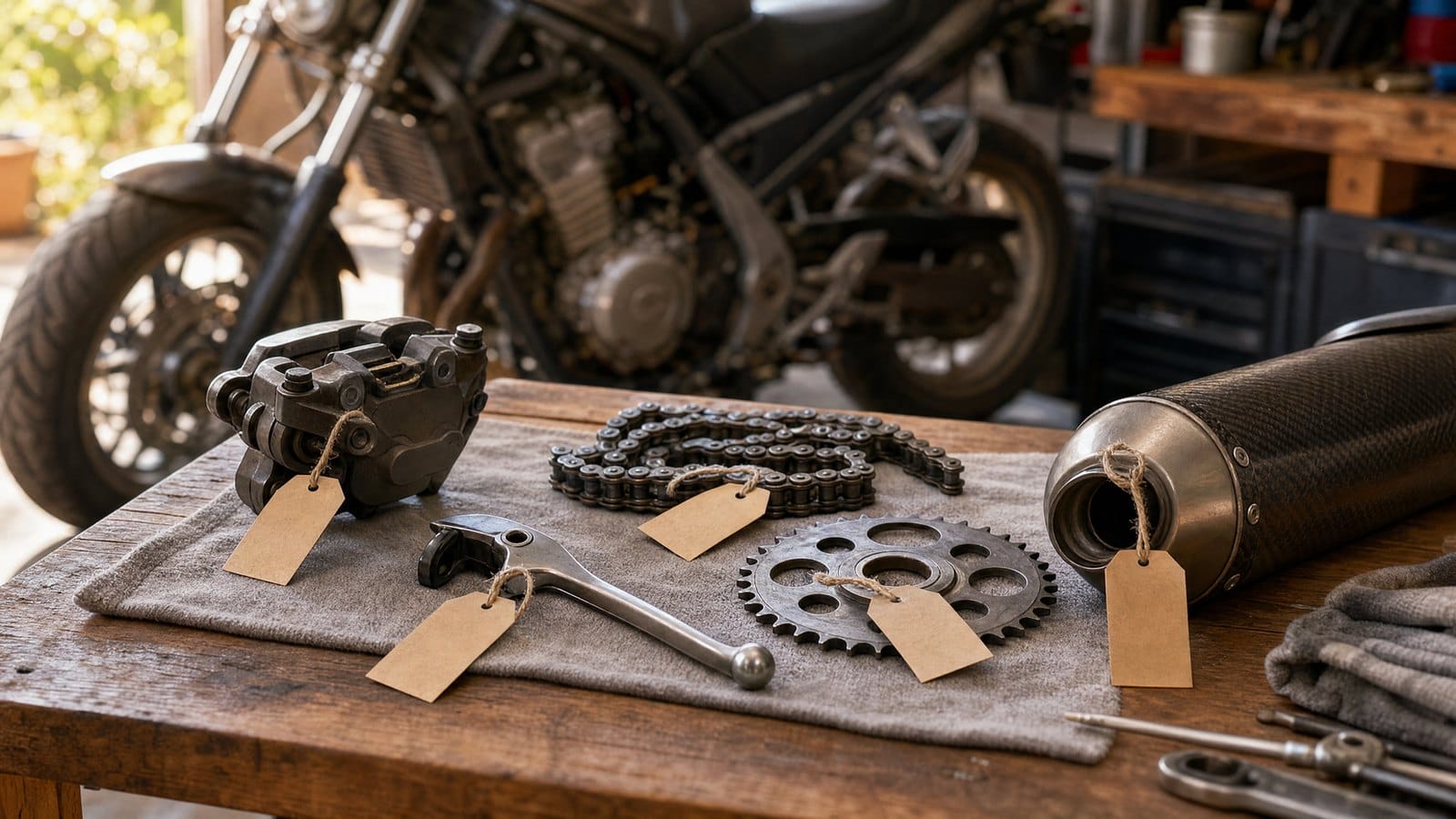
To sell used motorcycle parts online in the UK, list each part by its OEM part number and the exact make, model, years and frame number range it fits, and keep paperwork that shows where it came from. A rider who fits a frame or engine has to give DVLA evidence, so your receipt must carry the frame or engine number, and a used frame should come with the donor bike's V5C. Exhausts marked "NOT FOR ROAD USE" cannot be used on a road, and brake parts need measured wear figures. Helmets and riding kit are covered in our guide to selling motorcycle gear, and private seller and trader rules in the guide to selling used car parts.
Record the donor bike before you strip it
Write these down while the bike is still whole:
- The registration number, make and model.
- The frame number (VIN) and the engine number. Photograph both stamps.
- The year of manufacture and the date of first registration. The DVLA vehicle enquiry service shows both from the registration number.
- The mileage. MOT history records the mileage at each test, and for motorcycles it covers tests done since 2005.
- Its history: running, non-runner, known fault, or accident damage, and where the damage was.
Then find the OEM part number on each part: stamped, cast or on a label. Copy it exactly, suffix included, and check it against the manufacturer's parts catalogue or with a franchised dealer, quoting the frame number, so you know which production run your part belongs to.
Write a fitment table buyers can check
"Fits most 600s" invites returns. Give each listing a fitment block with one line per bike and three levels of certainty:
- Removed from: the donor bike, with its year and frame number.
- Same part number listed for: other models and years where the catalogue shows the same OEM number. A catalogue check, not a test fit.
- Not confirmed: anything you cannot check. Say so rather than guess.
A hypothetical example for a fuel tank: "Removed from: [model], 2009, frame number [VIN]. Same part number listed for: [model], 2008 to 2010, from frame number [first] to [last]. Not confirmed: 2011 models; the catalogue shows a different part number from 2011." Ask buyers to compare the part number with the one on their own bike before they order.
Frames: the VIN and the paperwork go together
All vehicles registered in the UK must have a unique, stamped-in VIN and a registration number (GOV.UK: vehicle identification number). A keeper who replaces a motorcycle frame must tell DVLA on form V627/1; for a used frame, the evidence includes the V5C of the vehicle it came from and a receipt giving the frame's specification (GOV.UK: what evidence to give). DVLA then confirms the original VIN can be stamped onto the replacement frame (GOV.UK: repairs and restorations). If a vehicle's age or identity is in doubt, DVLA issues a registration starting with Q (GOV.UK: Q registration numbers).
A checklist for selling a frame:
- Say whether the donor bike's V5C comes with it. If not, put that in the title.
- Issue a receipt with the frame number, make, model, date and both parties' names.
- Photograph the VIN stamp, the headstock and the engine mounts.
- If the bike was an insurance write-off, give the category. Category A means the entire vehicle has to be crushed; category B means the body shell has to be crushed and other parts can be salvaged; N and S can be repaired (GOV.UK: insurance write-offs). Do not offer a category A or B frame as the basis of a rebuild.
- Do not sell a frame whose number has been ground, restamped or damaged. The MOT treats a VIN that is incomplete, illegible or obviously falsified as a major defect (MOT inspection manual for motorcycles, section 0.2).
Engines: put the number and capacity on the receipt
A keeper who fits a different engine must update the V5C, and DVLA accepts as evidence a receipt for the replacement engine that includes the engine number and cylinder capacity (GOV.UK: what evidence to give). Put both on every engine receipt, with the donor's registration and frame number. In the listing, give:
- how you know the mileage: odometer, MOT history, or unknown
- whether it ran before removal, with a dated running video if you have one
- compression readings, cylinder by cylinder
- what is included: carburettors or throttle bodies, starter, alternator, wiring
Stolen parts: show where yours came from
In England and Wales, a person who dishonestly receives or helps sell goods, knowing or believing them to be stolen, commits handling stolen goods, with a maximum of 14 years' imprisonment (Theft Act 1968, section 22). For every donor bike, keep the purchase receipt, a copy of the V5C, photos of the complete bike showing the plate and VIN, and the MOT history printout. Offer to show buyers the donor's registration, and do not buy stock with numbers removed or no paperwork. Our guide to avoiding scams and fake buyers covers the payment side.
If you buy bikes to break, two more rules apply. GOV.UK says that if you buy a vehicle solely to remove parts to sell, the parts must be removed at an authorised treatment facility (GOV.UK: scrapping your vehicle). And a business that recovers parts from motor vehicles for re-use or sale and then scraps the rest is a motor salvage operator, which in England and Wales needs a scrap metal licence (Scrap Metal Dealers Act 2013, section 21 and section 1).
Exhausts: the "NOT FOR ROAD USE" marking
A business must not supply or offer a motorcycle exhaust system or silencer that fails the prescribed requirements (Motor Cycle Noise Act 1987, section 1). The silencer must be clearly and indelibly marked as the EU directive named in the Regulations requires, or "BS AU 193/T2", "BS AU 193a: 1990/T2" or "BS AU 193a: 1990/T3" (Motor Cycle Silencer and Exhaust Systems Regulations 1995, regulation 3). The rule does not apply if the silencer is clearly and indelibly marked, in characters at least 3 mm high, "NOT FOR ROAD USE" or words to that effect, or "PRE 1985 MC ONLY", or if it is sold as scrap for its metal value (regulation 5). Breaking the rule can mean up to three months' imprisonment or a level 5 fine (Motor Cycle Noise Act 1987, Schedule).
The rider is caught too: no one may use a motorcycle on a road if any part of its exhaust has been indelibly marked by its manufacturer "NOT FOR ROAD USE" or words to that effect (Road Vehicles (Construction and Use) Regulations 1986, regulation 57A(13)). So for every exhaust:
- photograph the marking on the silencer, whatever it says
- never call a can marked "NOT FOR ROAD USE" road legal; repeat the wording in the title
- say whether the baffle is included, and whether it is a slip-on or a full system
At the MOT, noise must not be clearly unreasonably above a similar bike with a standard silencer in average condition (MOT inspection manual for motorcycles, section 8).
Brakes and other safety-critical parts
Give measurements, not adjectives. The motorcycle MOT treats a brake pad worn below 1.0 mm as a dangerous defect and a pad contaminated with oil or grease as a major one (MOT inspection manual for motorcycles, section 1.1.13). So:
- measure the friction material on each pad and give the figure
- give measured disc thickness, any minimum stamped on the disc, and any cracks or warping
- say whether calipers and master cylinders worked when removed
- check the model and part for safety recalls; the GOV.UK recall check covers motorcycles and components and parts
Brake linings containing asbestos must not be supplied for fitting to a vehicle, and the old exemption for pre-1973 vehicles ended on 1 January 2005 (Road Vehicles (Brake Linings Safety) Regulations 1999, regulation 3). If you cannot show that old stock shoes or pads are asbestos-free, do not sell them for fitting. For forks, wheels and yokes, say whether the donor bike crashed and on which side.
Grade condition and photograph the proof
Publish one scale in every listing:
- Grade A: removed from a running bike, tested, light marks only.
- Grade B: working, with cosmetic damage listed and photographed.
- Grade C: works but needs attention, such as a stripped thread.
- Spares or repair: untested or faulty, sold for parts.
Say how you tested: "ran on the bike" is not "bench tested". Photograph the part number, every mounting point and connector, each fault with a ruler for scale, exhaust markings, and the complete donor bike as proof of origin.
Pricing
Search sold listings by exact part number, not by model name, and compare grade with grade. A frame with the donor V5C is a different item from a bare frame. For engines and frames, settle delivery or collection first and price with that cost in mind.
Packing heavy and oily parts
- Drain oil, fuel and coolant, cap every port and bag the part with absorbent material. Royal Mail's list of prohibited and restricted items includes used engine oil and used batteries under environmental waste, and asbestos and batteries have their own entries (Royal Mail: prohibited and restricted items).
- Remove the battery and sell it separately.
- Use a double-walled box, cover sharp edges, and pack so the part cannot move.
- Weigh and measure the packed box. Parcelforce's express48large takes parcels up to 30 kg, up to 2.5 m long, with length and girth combined up to 4 m (Parcelforce: large parcel delivery).
- Over those limits, use a pallet service or offer collection, and say which in the listing.
Where MC999 fits
MC999 is a UK online marketplace with no commission on sales; sellers pay a monthly fee. If you run a Shopify, BigCommerce or Shopline store, you can connect it, and buyers complete the purchase on your own website. Without a web shop, you can list parts manually and arrange payment with the buyer directly. The first 300 eligible UK sellers get six months with no monthly fee: see the Founding Seller details.
FAQ
Can I sell a used frame without its V5C?
Yes, but say so clearly. GOV.UK lists the donor vehicle's V5C among the evidence a keeper sends DVLA for a used replacement frame, so buyers need to know before they commit.
Do the exhaust marking rules apply to private sellers?
The Motor Cycle Noise Act 1987 covers supply in the course of a business. A private seller is not caught by it, but anyone riding on a road with a silencer marked "NOT FOR ROAD USE" commits an offence, so describe the marking accurately.
Do I need a licence to break bikes for parts?
A business that recovers parts from motor vehicles for re-use or sale and scraps the rest is a motor salvage operator and needs a scrap metal licence in England and Wales. Taking parts off your own bike to repair another bike you own is treated differently in GOV.UK's scrapping guidance.
Sources (checked 2 November 2026)
- GOV.UK: Vehicle registration, vehicle identification number
- GOV.UK: Vehicle registration, repairs and restorations (replacing a motorcycle frame, V627/1, restamping)
- GOV.UK: Vehicle registration, Q registration numbers
- GOV.UK: Change vehicle details on a V5C (engine and frame changes)
- GOV.UK: Change vehicle details on a V5C, what evidence to give
- GOV.UK: Insurance write-off categories
- GOV.UK: Scrap your vehicle and keep parts from it (ATF rule)
- GOV.UK: Get vehicle information from DVLA
- GOV.UK: Check the MOT history of a vehicle
- GOV.UK: Check if a vehicle, part or accessory has been recalled
- DVSA MOT inspection manual for motorcycles, section 0 (0.2 VIN)
- DVSA MOT inspection manual for motorcycles, section 1 (1.1.13 brake linings and pads)
- DVSA MOT inspection manual for motorcycles, section 8 (exhaust noise)
- Theft Act 1968, section 22 (handling stolen goods)
- Scrap Metal Dealers Act 2013, section 21 (motor salvage operator)
- Scrap Metal Dealers Act 2013, section 1 (licence requirement)
- Motor Cycle Noise Act 1987, section 1
- Motor Cycle Noise Act 1987, Schedule (offences and penalties)
- Motor Cycle Silencer and Exhaust Systems Regulations 1995, regulation 3
- Motor Cycle Silencer and Exhaust Systems Regulations 1995, regulation 5 (NOT FOR ROAD USE exemption)
- Road Vehicles (Construction and Use) Regulations 1986, regulation 57A
- Road Vehicles (Brake Linings Safety) Regulations 1999, regulation 3 (asbestos)
- Royal Mail: Prohibited and restricted items, personal customer guidelines
- Parcelforce: Large parcel delivery (express48large size and weight)