Earrings and Nickel: UK Rules for Jewellery Sellers
What UK REACH allows for nickel release from earrings, piercing posts and other jewellery, the lead and cadmium limits, how to get and check EN 1811 test reports, what nickel free, hypoallergenic and surgical steel can honestly mean, and how sealed earrings affect returns.
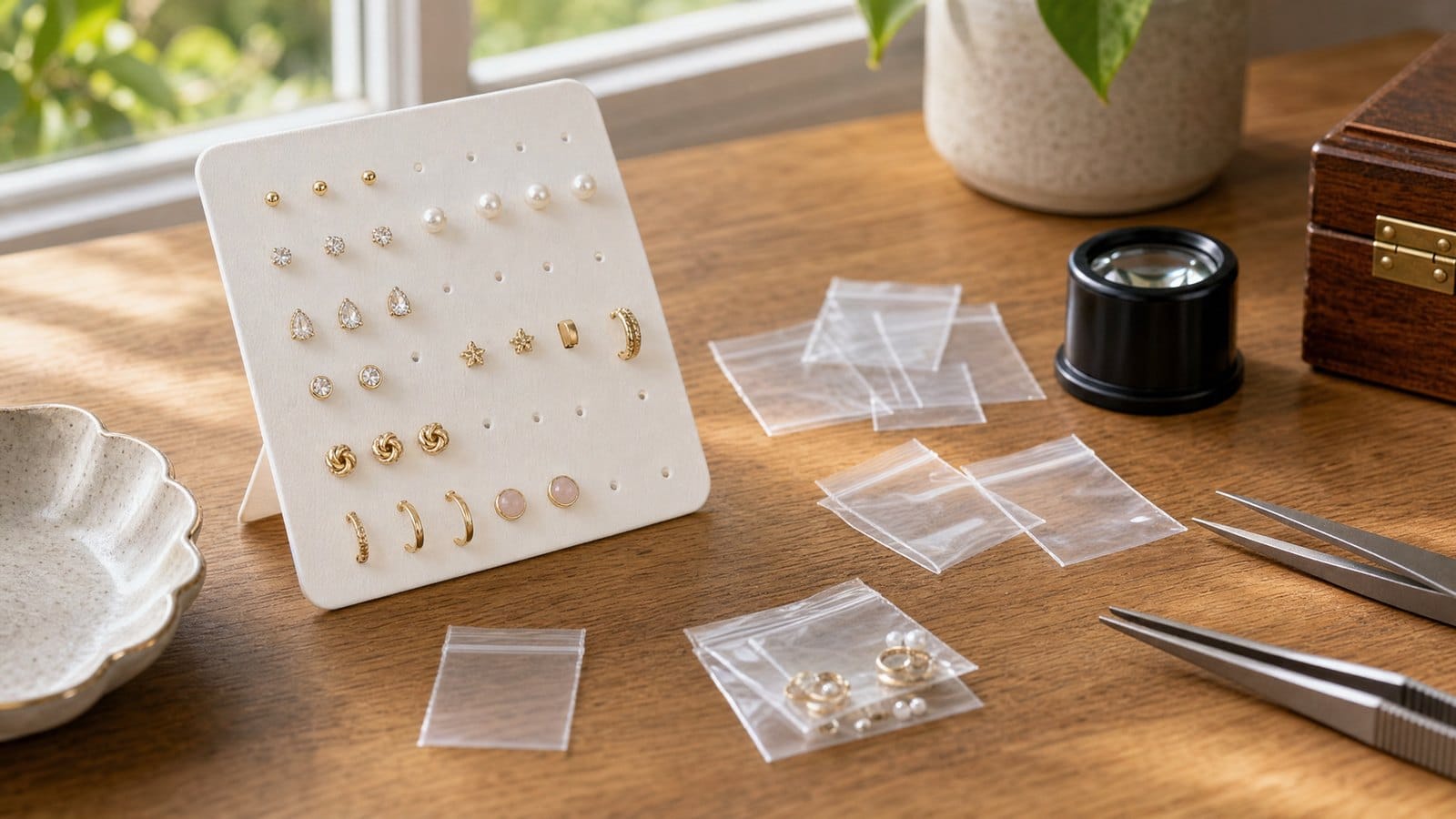
If you sell earrings or other jewellery in Great Britain, the nickel rule is a limit on how much nickel the piece releases, not a ban on nickel. Under entry 27 of Annex XVII to UK REACH, anything inserted into a pierced ear or other piercing must release less than 0.2 µg/cm² per week, and earrings, necklaces, bracelets, rings and watch parts in direct and prolonged skin contact must not release more than 0.5 µg/cm² per week. Separate entries cap lead and cadmium. The evidence is a lab test to EN 1811, and your listing wording has to match what that test shows.
This guide covers chemical limits, test reports, claims like "nickel free" and returns of pierced earrings. For photos, sizing and general jewellery returns, see the guide to selling jewellery online in the UK. For gold, silver and the Dealer's Notice, see hallmarking rules for selling jewellery online.
What the nickel restriction says
The text of UK REACH Annex XVII, entry 27 on legislation.gov.uk sets three limits:
- Post assemblies inserted into pierced ears and other pierced parts of the body: nickel release must be less than 0.2 µg/cm² per week.
- Articles in direct and prolonged contact with the skin: the list names earrings, necklaces, bracelets and chains, anklets, finger rings, watch cases, watch straps and tighteners, and metal fittings on garments. The parts touching the skin must not release more than 0.5 µg/cm² per week.
- Coated articles from that list: where a non-nickel coating covers the metal, it must keep release at or below 0.5 µg/cm² per week for at least two years of normal use.
Paragraph 2 says articles that do not conform "shall not be placed on the market", and paragraph 3 makes the CEN standards the test methods. A practical reading for one pair of studs: the post that goes through the ear works to the 0.2 limit, while the front or back that rests on the earlobe works to 0.5. Ask the lab to test each part against the limit that applies to it.
The HSE explains that UK REACH covers Great Britain and that EU REACH continues to apply in Northern Ireland. If you sell to buyers in Northern Ireland, EU REACH applies to those sales, so check the EU text as well.
Lead and cadmium: the other two limits
Two more entries in the same Annex apply to every earring you sell.
- Lead, entry 63: no individual part of a jewellery article may contain 0.05% lead or more by weight. "Jewellery articles" expressly includes piercing jewellery and hair accessories, and the limit also applies to parts sold for jewellery making. Natural or reconstructed precious and semi-precious stones not treated with lead, crystal glass, enamels and inaccessible watch parts are exempt, as are pieces first placed on the market before 9 October 2013 and pieces produced before 10 December 1961.
- Cadmium, entry 23, paragraph 10: metal parts of jewellery, including piercing jewellery, and metal beads and components for jewellery making must contain less than 0.01% cadmium by weight of the metal. Paragraph 11 exempts articles placed on the market before 10 December 2011 and jewellery more than 50 years old on that date.
Entry 27 has no equivalent date exemption for nickel. For vintage pieces, the lead and cadmium dates can help, so keep any evidence of age.
What goes wrong in practice
GOV.UK's product safety reports list earrings that failed these limits. Three show the pattern:
- A batch of costume earrings found to release nickel above the permitted limit was rejected at the border in 2024. The report was notified by local Trading Standards.
- Gold-coloured hoops sold through a social media shop contained excess cadmium, nickel and lead; in 2025 they were withdrawn, and the marketplace removed the listing.
- Earrings listed as "925 Sterling Silver" on an online marketplace contained more lead than permitted, and the listing was removed.
A precious metal description did not stop the last one failing. Before you reorder from a supplier, search the reports by product type.
Getting test evidence
The reference method is EN 1811. BSI lists BS EN 1811:2023 as current. It covers post assemblies and skin-contact articles and is written to check conformity with entry 27. For plated or coated pieces, BS EN 12472:2020 adds accelerated wear and corrosion before the nickel test. Its scope excludes items inserted into pierced ears, so a plated post is still tested to EN 1811.
Use a lab accredited to ISO/IEC 17025. Birmingham Assay Office, for example, runs a UKAS-accredited analytical laboratory that tests jewellery for nickel release, lead and cadmium.
- Ask your supplier for existing EN 1811, lead and cadmium reports before you order.
- Check that each report names the same item or style code, the standard used, the result for each part and the limit it was compared against.
- Check the lab's accreditation and that the tested method is on its schedule.
- If the report is for a different style, an old batch or a different plating, send a sample of your own stock.
- Keep the report with the style code and supplier invoice, so you can answer Trading Standards or a buyer quickly.
What "nickel free" and "hypoallergenic" can honestly mean
Neither phrase appears in entry 27. The law sets release limits, so a pass to EN 1811 shows the piece meets UK REACH. It does not show the piece contains no nickel. Since 6 April 2025, section 226 of the Digital Markets, Competition and Consumers Act 2024 treats false or misleading product information as a misleading action, including true information presented in a misleading way. Section 225 prohibits unfair commercial practices.
- "Meets UK REACH nickel release limits": fine when you hold a passing EN 1811 report for that item.
- "Nickel free": only when the composition evidence shows no added nickel in every part, including the back and any solder or plating. A passing release test alone does not support it.
- "Hypoallergenic": there is no definition in entry 27. Some labs sell their own tests for the claim: Birmingham Assay Office's AnchorCert Protect screens for 16 allergenic metals. If you use the word, say what was tested and by which lab, and keep the report.
- "Safe for sensitive ears": avoid it. It is a promise about the buyer's skin that no lab test covers.
Metals for sensitive ears, described accurately
The Association of Professional Piercers (APP) publishes a materials list for initial piercing jewellery. Use the material names in that list only when your evidence matches them.
- Titanium: ASTM F136 covers wrought Ti-6Al-4V ELI alloy for surgical implants. The APP also lists ASTM F1295, ISO 5832-3 and commercially pure titanium to ASTM F67. Write "implant grade" only with a mill certificate naming the grade.
- Surgical steel: the APP says it covers many alloys, and only some grades are proven, such as ASTM F138 or ISO 5832-1. ASTM F138 is an 18 chromium, 14 nickel, 2.5 molybdenum stainless steel, so implant steel contains nickel. Never call it nickel free; state the grade and the EN 1811 result.
- Niobium: the APP says it is similar to titanium but has no implant-grade designation, so do not call it "implant grade".
- Gold: the APP's condition is 14k or higher, nickel- and cadmium-free and alloyed for biocompatibility. Gold-plated, gold-filled and vermeil pieces are not acceptable for fresh piercings. Solid gold described as gold needs a hallmark once the metal weighs 1 gram or more, under Schedule 1 of the Hallmarking Act 1973.
The APP notes that a mill certificate shows a grade of metal but cannot prove your piece came from that batch. Treat it as supplier evidence, with an EN 1811 report as the check on the finished item.
Example title: "Titanium stud earrings, ASTM F136 posts and backs, 4 mm cubic zirconia, tested to EN 1811". Avoid: "Hypoallergenic surgical steel earrings, nickel free, safe for all ears".
Hygiene, sealed packaging and returns
Online buyers normally have 14 days to cancel. Under regulation 28(3)(a) of the Consumer Contracts Regulations 2013, that right ends for sealed goods not suitable for return for health protection or hygiene reasons, if they become unsealed after delivery. GOV.UK gives underwear as the example; earrings are not named, so the exception only works on your side if you set it up properly:
- Seal each pair in a bag or box the buyer has to break to wear them, with a seal label.
- Before the order is placed, state that the right to cancel is lost once the seal is broken. Regulation 13 and Schedule 2, paragraph (o) require this before the buyer is bound.
- Accept returns of unopened pairs within the normal 14 days.
- Refund faulty or not-as-described pairs whatever the seal. That includes a pair you described as titanium that turns out not to be.
Put a card in the pack naming the metal of the post and the back, with the style code that links to your test report.
Photos that support the description
- Shoot the post and the back separately, so buyers see what passes through the ear.
- If the back is a different material, for example, silicone or steel butterflies with titanium posts, show it and say so in the title.
- Photograph the sealed pack as the buyer will receive it.
The same nickel limits apply to watch straps and cases, so check those parts too when you sell a watch online.
Where MC999 fits
MC999 is a UK online marketplace with no commission on sales; sellers pay a monthly fee. If you run a Shopify, BigCommerce or Shopline store, you connect it and buyers complete the purchase on your own website. Without a web shop, you can list items manually and arrange payment with the buyer directly. You can browse the Jewellery and Watches category to see how other sellers list. The first 300 eligible UK sellers get six months with no monthly fee: see how to become a Founding Seller.
FAQ
Does the nickel limit apply to nose studs and belly bars?
Yes. Entry 27 covers post assemblies inserted into "pierced ears and other pierced parts of the human body", so the 0.2 µg/cm² per week limit applies to any body jewellery that passes through a piercing. Lead and cadmium entries also name piercing jewellery.
My supplier says the earrings are 316L steel. Is that enough?
No. A grade name tells you the alloy family, not the nickel release of the finished, polished piece. Ask for an EN 1811 report for that style, or have a sample tested, and describe the steel by grade rather than as nickel free.
Can a buyer return earrings they have tried on?
If the pair was sealed, you said before purchase that the right to cancel ends once the seal is broken, and the buyer broke it, you can refuse a change-of-mind return. If the earrings are faulty or not as described, the buyer is still entitled to a remedy.
Sources (checked 2 November 2026)
- UK REACH Annex XVII: entry 27 nickel limits (0.2 and 0.5 µg/cm² per week, two-year coating rule, CEN test methods), entry 63 lead 0.05% and date exemptions, entry 23 paragraphs 10 and 11 cadmium 0.01% and exemptions
- HSE: UK REACH applies in Great Britain; EU REACH continues to apply in Northern Ireland
- GOV.UK: product safety alerts, reports and recalls search
- OPSS report 2405-0009: earrings releasing nickel above the limit, rejected at the border, notified by Trading Standards
- OPSS report 2507-0125: earrings with excess cadmium, nickel and lead withdrawn, marketplace listing removed
- OPSS report 2103-0230: earrings listed as 925 sterling silver with excess lead, listing removed
- BSI: BS EN 1811:2023, current, reference test method for nickel release, checks conformity with entry 27
- BSI: BS EN 12472:2020, wear and corrosion simulation for coated articles, excludes items inserted into pierced ears
- Birmingham Assay Office: UKAS-accredited ISO/IEC 17025 laboratory, nickel release, lead, cadmium and hypoallergenic testing
- Birmingham Assay Office: REACH testing for nickel, lead, cadmium; AnchorCert Protect 16-metal screen
- DMCC Act 2024, section 225: unfair commercial practices prohibited
- DMCC Act 2024, section 226: misleading actions, in force 6 April 2025
- Association of Professional Piercers: materials for initial piercings, steel and titanium grades, niobium, gold, mill certificates
- ASTM F136: wrought Ti-6Al-4V ELI alloy for surgical implants
- ASTM F138: 18 chromium, 14 nickel, 2.5 molybdenum stainless steel for surgical implants
- Hallmarking Act 1973, Schedule 1: gold exemption under 1 gram
- Consumer Contracts Regulations 2013, regulation 28(3)(a): right to cancel lost for unsealed hygiene goods
- Consumer Contracts Regulations 2013, regulation 13: Schedule 2 information before the consumer is bound
- Consumer Contracts Regulations 2013, Schedule 2 paragraph (o): tell buyers when the right to cancel is lost
- GOV.UK: 14-day cancellation, sealed hygiene items example, refunds for faulty or not as described goods