How to Sell Bike Racks and Towbars Online in the UK
A UK seller's guide to towbars and bike racks: record the fitment and approval label, name the towbar type, list 7- or 13-pin electrics, give rack weight and load figures, check straps, locks and keys, and choose between courier and collection.
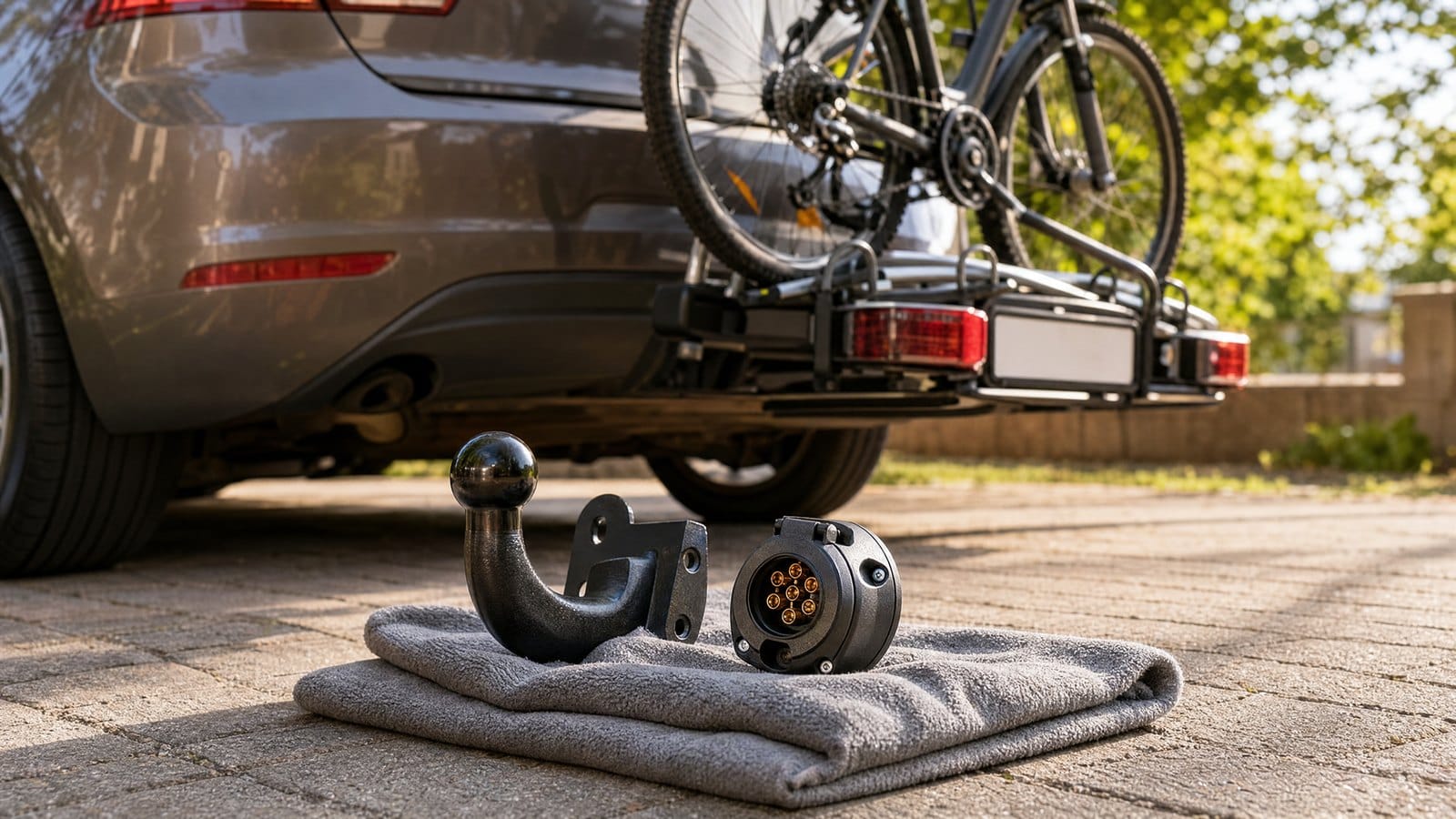
To sell a bike rack or towbar online in the UK, give buyers the exact vehicle it fits, the towbar type, the electrics (7-pin or 13-pin, vehicle-specific or universal) and the load figures from the manufacturer, then show the approval label, every key and a working light board in your photos. A towbar for a car first used from 1 August 1998 must be type approved, so buyers will ask to see the label. This guide covers what is specific to towbars and racks; for fit lists and roof loads in general, see the guide to selling car accessories, and for part numbers and private or trader rules, see the guide to selling used car parts.
Identify the towbar before you write a word
Take the towbar out of the box and find the type plate. Copy these details into your notes:
- Manufacturer and part number.
- The vehicles on the label: make, model, years and body type. Copy the body type exactly as the label gives it.
- The approval number.
- The D-value in kN and the vertical load (nose weight) in kg.
- The weight of the towbar itself, which you need for postage.
A real example of what a manufacturer lists: the Westfalia A40V detachable towbar (part 303412600001) weighs 23 kg, has a vertical load of 90 kg, a D-value of 11.9 kN, approval number 55R-01 11132 and needs no bumper cut-out. Put the same set in your listing, and tell buyers that the figure in their vehicle documents takes priority, as Westfalia says.
Name the towbar type correctly
Buyers filter by type, and the type decides which racks fit. Witter describes four:
- Fixed flange: bolts to the flange plate with 2 or 4 bolts and takes bolt-on accessories such as bike racks, bumper protectors and stabilisers.
- Detachable flange: works like a fixed flange, but the neck comes off with a lock and key.
- Fixed swan neck: a one-piece towball that works with most ball-mounted bike racks.
- Detachable swan neck: removable when not in use, with anti-theft locking, and Witter says it is compatible with all ball mount cycle carriers.
Witter also says its spare necks are not universal: each one is made for a specific Witter towbar. If you sell a detachable towbar, say whether the neck, receiving socket, both keys and the fitting instructions are included.
Show the type approval label
GOV.UK says a towbar must be type approved, which means it meets EU regulations and is designed for that car, and that the label shows an approval number and the vehicles it is approved for. If the car was first used before 1 August 1998, the towbar does not need to be type approved. The legal rule is regulation 86B of the Road Vehicles (Construction and Use) Regulations 1986: it applies to light passenger vehicles first used on or after 1 August 1998 that have an EC certificate of conformity, and the coupling device must meet Directive 94/20 and be marked.
In practice:
- Photograph the label so the approval number and vehicle list are readable.
- If the label is missing or worn away, say so in the title. Westfalia says it can no longer post replacement type plates to owners and sends them to the repair shop instead, so replacing a lost plate goes through a garage.
- Only list cars that appear on the label or in the manufacturer's fitting list.
List the electrics separately
A towbar without wiring is half a job for the buyer. Westfalia explains the difference: a 7-pin kit carries tail, brake, indicator and rear fog lights; a 13-pin kit adds reverse light, a permanent positive line and a charging line, and Westfalia calls 13-pin the stronger choice for bike carriers.
State whether the kit is vehicle-specific or universal. Vehicle-specific kits use plugs that match the car's own connectors and control unit software, with support for functions such as parking sensor shutdown. Brink recommends a vehicle-specific kit because current cars have complex digital systems that a universal kit will not support. Give the kit's part number and the car it came off.
Adapters matter for racks too. According to Westfalia, a 7-pin to 13-pin adapter only extends the 7-pin functions, while a 13-pin to 7-pin adapter suits a cycle carrier with a 7-pin plug. If you sell a 13-pin rack, add one line: on a car with 7-pin electrics, it needs an adapter.
Test the socket before you take the towbar off. At the MOT, the inspection manual (section 4.10) treats a 13-pin trailer socket that is not functioning correctly as a major defect, and one that is not functioning at all as dangerous.
Give three load figures for every rack
For each rack, list its own weight, its load capacity and its maximum weight per bike. Examples from Thule's UK site:
- Towbar-mounted: the VeloCompact 2 13-pin weighs 14.2 kg, has a 46 kg load capacity and a 25 kg maximum bike weight, and folds to 106 x 66 x 30 cm.
- Boot-mounted: the OutWay Hanging 2 and OutWay Platform 2 each take 2 bikes at a maximum of 15 kg per bike.
- Roof: the ProRide has a 20 kg load capacity and needs a roof rack system already fitted.
Nose weight is where towbar racks go wrong. The Thule Xpress 2 instructions say to check the towbar's ball load in the car manual, that the lower limit applies if it is lower than the carrier's maximum, and that maximum load equals the carrier's weight plus the bikes. A worked example: a 14.2 kg rack with two 20 kg bikes puts 54.2 kg on the ball. Giving the rack weight lets the buyer do that sum for their own car.
For a boot-mounted rack, also say whether the hooks are padded or coated; Thule recommends this to protect the paint.
Number plate and lights
Thule's Xpress 2 instructions state that the carrier and bikes obstruct the car's tail-lights and number plate, so a tail-light bar should be fitted. The law on the plate is section 43 of the Vehicle Excise and Registration Act 1994: if the registration mark is obscured or not easily distinguishable, the driver commits an offence, with a fine of up to level 3 on the standard scale. The towbar itself is checked too: the MOT manual (section 6.1.6) lists a towbar obstructing the plate or any lamp as a minor defect, and a plate made unreadable as a major one.
In the listing, say whether the rack has a built-in light board, whether every function works, and whether the plate holder is empty. The rule on who can make up a plate is in the car accessories guide. Some boot racks avoid the problem: Thule describes the OutWay Platform 2 as a raised design that keeps the plate and lights visible.
Condition checks for a used rack or towbar
Work through this before you photograph anything:
- Straps and ratchets: look for cracks, fraying and ratchets that slip. Thule's instructions say damaged or worn parts should be replaced immediately, so list any you find.
- Locks and keys: count the keys and try each lock, including the lock that secures the rack to the towbar. Thule sells a One-Key System set of 4 lock cylinders for £34.99, which gives a buyer a figure for what missing keys will cost.
- Lights: connect the rack to a car and check tail, brake, both indicators and fog. On a 13-pin rack, check the reverse light too.
- Moving parts: fold and unfold the rack and try the tilt pedal with the rack loaded.
- Towbar wear: the MOT manual says testers reject pins, jaws or hooks worn by more than 25% of their original thickness and tow balls that are obviously excessively worn. The manual also notes that some detachable tow balls have play of up to 3 mm, measured at the ball end. Photograph any corrosion.
- Bits: fitting bolts, adapters, wheel straps, the manual and any vehicle-specific fit kit.
Photos that answer the questions
- The towbar type plate, close enough to read.
- The wiring kit plugs and the socket face, showing the pin count.
- The rack fitted to a car with the lights switched on.
- Every key next to its lock.
- Straps, clamps and wheel trays close up.
Post it or offer collection
Weigh and measure the packed box before you choose. The Royal Mail Tracked 48 medium parcel limit is 20 kg and 61 x 46 x 46 cm, with compensation cover up to £75. A 23 kg towbar is already over that weight, and a rack that folds to 106 cm is over the length.
Parcelforce express48 on a business account takes parcels up to 30 kg and 1.5 metres long with a maximum volume of 220 litres, with a surcharge above that; sent through the Post Office, the limit is 1.5 metres long and 3 metres length and girth combined. The folded VeloCompact 2 works out at about 210 litres before packaging, so measure the box, not the rack. For bigger items, Parcelforce's large parcel service takes up to 2.5 metres in length and 4 metres length and girth combined, at up to 30 kg per parcel.
Collection lets the buyer see the lights working on their own car, which answers the electrics question on the spot. Agree payment before the visit; the guide to avoiding scams and fake buyers covers safe ways to do that.
Pricing
Search sold listings for the exact model and compare like with like:
- A towbar with its vehicle-specific wiring kit is a different product from a bare towbar. Price them separately if you have both.
- A towbar with a readable approval label is worth more than one without.
- Take the cost of replacement keys or cylinders off a rack with keys missing.
- Price collection-only items with the buyer's travel in mind, and price posted items with the courier charge for the packed size.
Where MC999 fits
MC999 is a UK online marketplace with no commission on sales; sellers pay a monthly fee. If you run a Shopify, BigCommerce or Shopline store, you can connect it, and buyers complete the purchase on your own website. Without a web shop, you can list items manually and arrange payment with the buyer directly. The first 300 eligible UK sellers get six months with no monthly fee: see the Founding Seller details.
FAQ
Can I sell a towbar that has lost its approval label?
You can, but say so in the title and description. GOV.UK says towbars on cars first used from 1 August 1998 must be type approved and labelled, and Westfalia only sends replacement plates to repair shops, so replacing it means going through a repair shop. A towbar for a car first used before that date does not need approval.
Will a 13-pin bike rack work on a car with 7-pin electrics?
With a 7-pin to 13-pin adapter, yes for the basic lights. Westfalia says the adapter only extends the 7-pin functions, so features that need 13-pin, such as the reverse light, will not work.
Is play in a detachable tow ball a fault?
Not always. The MOT manual allows up to 3 mm of movement at the ball end between the receiver socket and the swan neck fitting on some detachable tow balls. Measure it and give the figure in the listing.
Sources (checked 2 November 2026)
- GOV.UK: Towing with a car, towing bars (type approval, label, 1 August 1998)
- Road Vehicles (Construction and Use) Regulations 1986, regulation 86B
- Vehicle Excise and Registration Act 1994, section 43
- DVSA MOT inspection manual, section 6.1.6 Coupling mechanisms and towing equipment
- DVSA MOT inspection manual, section 4.10 Trailer electrical socket
- Witter Towbars: towbar types
- Westfalia: Towbars guides and FAQ (vertical load, type plates, vehicle documents)
- Westfalia: Detachable Towbar (vertical) A40V technical data
- Westfalia: 13 or 7 pins, which wiring kit
- Westfalia: Which vehicle plug adapter do I need
- Westfalia: Towbar electrical wiring kits
- Brink UK: Wiring kit
- Thule Xpress 2 instructions (ball load, tail-light bar, straps)
- Thule VeloCompact 2 13-pin specifications
- Thule: Trunk bike racks (OutWay specifications)
- Thule: Roof bike racks (ProRide load capacity)
- Thule One-Key System 4-pack
- Royal Mail: Tracked 48 sizes and compensation
- Parcelforce: express48 size, weight and volume
- Parcelforce: Large parcel delivery