How to Sell an Engagement Ring Second-Hand in the UK
Selling a diamond engagement ring you own? Read the hallmark, check the GIA or IGI report number online, disclose lab-grown stones, get a valuation for sale rather than the insurance figure, price from sold rings and post it by Special Delivery with the right cover.
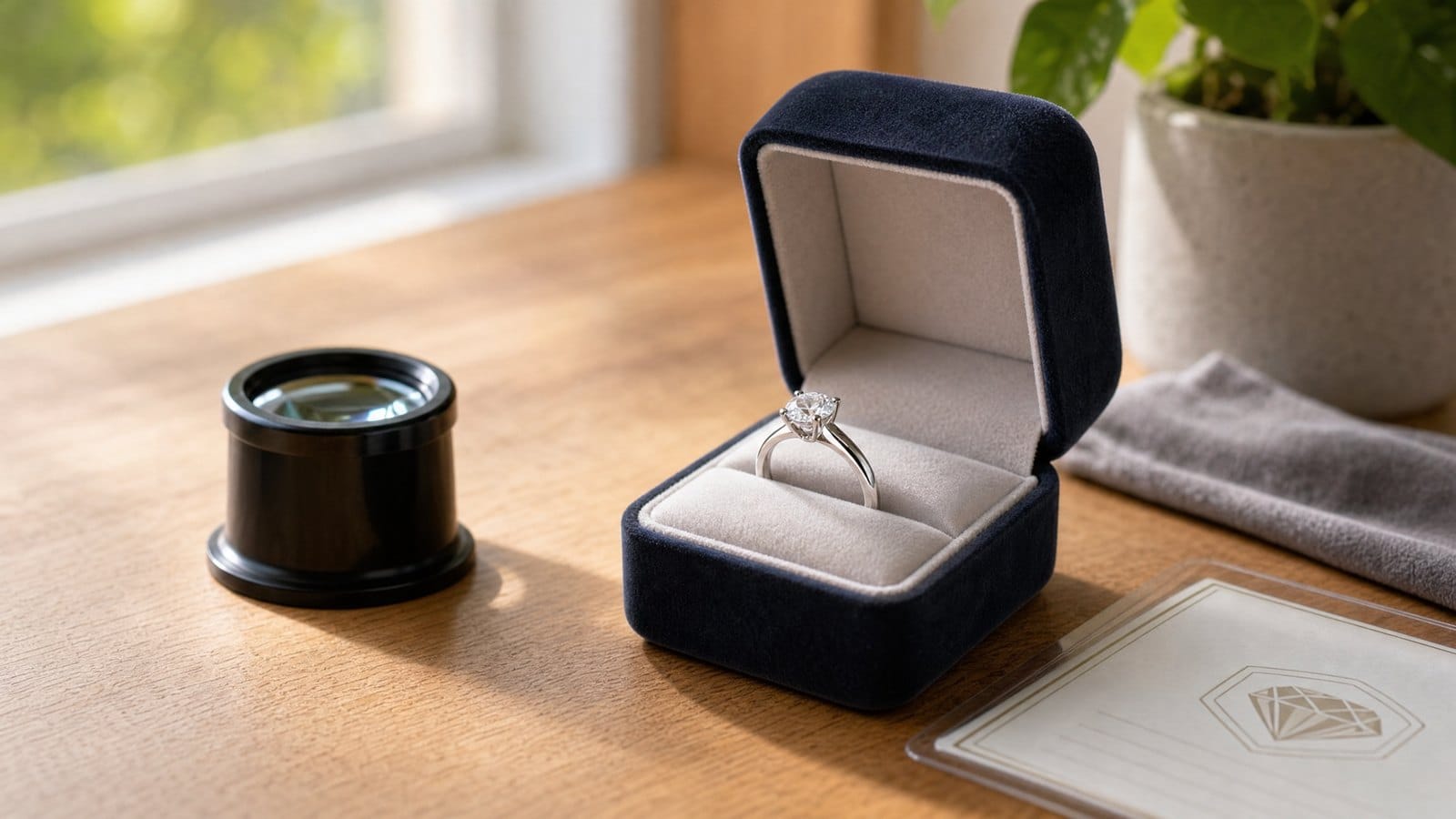
To sell a second-hand engagement ring in the UK, first prove what it is: read the hallmark for the metal, check the diamond's GIA or IGI report number on the lab's own website, and say plainly whether the stone is natural or laboratory-grown. Then get a written valuation for sale rather than relying on the insurance figure, use prices from rings with the same specifications that have actually sold, and post it by Royal Mail Special Delivery Guaranteed with cover that matches the price. That cover tops out at £2,500, so a dearer ring needs a hand-over in person or a specialist courier.
Our guide to selling jewellery online in the UK covers measurements and returns for shops, and the hallmarking rules for selling jewellery online explain the marks in detail. This guide covers one diamond ring you own.
Step 1: Gather the paperwork
Put together the receipt, the diamond grading report (often called the certificate), any insurance valuation with its date, resizing or repair invoices and the box. Each one answers a question a buyer would otherwise ask.
Step 2: Read the hallmark
Look inside the band with a loupe or a phone on macro. A UK hallmark has a sponsor's mark, a fineness number and an Assay Office mark. Under Schedule 2 of the Hallmarking Act 1973, the fineness figures for gold include 375, 585, 750 and 916, platinum includes 850, 900 and 950, and the Assay Office marks are a leopard's head (London), a castle (Edinburgh), an anchor (Birmingham) and a rose (Sheffield). The National Association of Jewellers gives the gold content: 9 carat is 37.5% fine gold, 18 carat is 75%.
The hallmarking offence in section 1 of the Act applies to people acting in the course of a trade or business, so it is aimed at dealers. A private seller still has to describe the ring accurately, though: under section 13 of the Sale of Goods Act 1979, goods sold by description must match it. If there is no hallmark, write "unmarked, metal not tested" or pay a jeweller or the Assay Office to test it.
Step 3: Describe the diamond using the 4Cs
GIA's diamond quality factors page sets out the grading terms buyers search for:
- Colour: graded on a D-to-Z scale; GIA says even a slight hint of colour can make a large difference in value.
- Clarity: 11 grades, from Flawless down through VVS, VS, SI and Included.
- Cut: as a general rule, the higher the cut grade, the brighter the diamond.
- Carat: one carat is 0.2 grams and 100 points, so a 0.71 carat stone is a "71 pointer".
Copy the grades word for word, including fluorescence: GIA notes that strong blue fluorescence can make a stone look cloudy and lower its value.
Check the report number online
- For a GIA report, enter the number at GIA Report Check. It confirms that the details on your paper report match GIA's database and, depending on the report date, shows a PDF copy.
- For an IGI report, enter the number, or scan the QR code, on IGI's Verify Your Report page.
- Compare shape, carat weight and measurements on the online record with the stone in your ring.
- If the report lists a girdle inscription, ask a jeweller to read it under magnification and note the result.
A report that verifies proves the report is genuine, not that the stone in your ring is the stone it describes. Checks 3 and 4 make that link for the buyer. IGI's own limitations text says a report is an opinion, not a guarantee or an appraisal, so never call it a valuation.
Step 4: Natural, lab-grown or simulant
According to GIA's page on simulants and lab-grown diamonds, laboratory-grown diamonds have the same crystal structure as natural ones and can look the same to the eye, while laboratories separate them with advanced instruments. GIA laser-inscribes the girdle of each laboratory-grown diamond it grades with the report number and a statement that it is laboratory-grown, so a lab-grown stone without a GIA report may carry no inscription. Simulants such as cubic zirconia, moissanite and glass are not diamonds at all.
Put the origin in the title: "laboratory-grown diamond" or "natural diamond". If the stone has never been tested, say so rather than writing "natural" from family memory. A buyer who later finds the description wrong may have a claim under the Sale of Goods Act; if you sell as a trader, the Consumer Rights Act 2015 applies instead, as section 13(5) notes.
Step 5: Independent valuation, not the insurance figure
The NAJ explains that a valuation is written for a particular purpose. A valuation for sale gives the "potential realisable values". An insurance valuation aims to replace a lost ring with one of the same type and quality. That replacement cost is what a jeweller would charge for a comparable ring, which is why the insurance figure is usually above what a private buyer will pay for a pre-owned one.
NAJ Institute Registered Valuers need at least five years in the trade, a gemmological qualification, a diamond grading qualification and the NAJ's Foundations of Appraisal Practice programme; search the Find a Valuer directory. Valuers charge for their time, and the NAJ suggests contacting at least three to compare costs. Bring your report and say the valuation is for sale.
The Birmingham Assay Office also offers valuations for private sale, by post or in person.
Step 6: Clean and photograph the ring
GIA's cleaning advice is simple: soak the ring in water with a few drops of mild dish soap, brush gently with a new soft toothbrush, rinse, and dry with a lint-free cloth. Close the sink drain first. Never use bleach or abrasives such as toothpaste, and avoid ultrasonic cleaners if the report shows fracture filling. Have a jeweller check the claws before you sell.
Shoot in daylight on a plain background:
- Top view of the stone, filling the frame.
- Side profile, showing setting height and claws.
- Inside the band, with the hallmark readable.
- Any wear, thinning or resizing seam.
- The report next to the ring, with the number readable.
- A short video turning the ring in daylight.
Step 7: Price it realistically
- Start from the realisable value in your sale valuation.
- Find rings that have sold, not those still listed, with the same metal, shape, carat range, colour, clarity and grading lab.
- Get offers from two or three jewellers or buyers. The NAJ notes that offers vary because each dealer deducts its own costs and profit, so shop around and be ready to haggle. These offers are your floor.
- Work out the metal value as a last resort. Using the NAJ method, a 4-gram 18-carat band holds 3 grams of fine gold (4 × 0.75); multiply that by the day's price per gram. The NAJ also points out that gemstones may be worth more than the gold.
Set your asking price between that floor and the sold prices, and decide your lowest figure before the first message arrives.
Tax: GOV.UK says you may have to pay Capital Gains Tax on a personal possession sold for £6,000 or more, and lists jewellery. Your gain is normally the sale price minus what you paid, or the market value if the ring was a gift or inherited, and you can deduct valuation and advertising fees. If you sold it for between £6,000 and £15,000, a reduced calculation may apply.
Step 8: Write the listing
Example title: "18ct white gold solitaire engagement ring, 0.71ct natural round diamond, GIA report, size M".
In the description, give:
- metal and hallmark
- shape, carat, colour, clarity, cut and fluorescence, copied from the report
- grading lab and report number, inviting buyers to check it online
- natural or laboratory-grown, stated clearly
- UK ring size and any resizing
- condition of the band and claws, and any repairs
- what is included, delivery method and payment terms
Leave out words the paperwork does not support, such as "flawless" unless the report says Flawless, or "investment".
Step 9: Post it signed for and insured
Royal Mail's valuables guidance lists diamonds, precious stones and manufactured precious metal as valuables and says to send jewellery by Special Delivery Guaranteed. On Special Delivery Guaranteed by 1pm, cover is £750 as standard, with options of £1,000 or £2,500. For an item up to 100g, the Post Office prices are £10.35, £13.35 and £20.35 for those three levels, or £9.85, £12.85 and £19.85 online. Delivery includes a photo and signature.
Pack the ring in a small box inside a padded outer box, photograph it going in, and buy cover for the full price. Above £2,500, Special Delivery cannot cover it: hand it over in person or use a courier that insures valuables to full value, after reading its terms on jewellery.
Step 10: Avoid the common scams
- Post only when the money shows in your own banking app. A "payment confirmation" email proves nothing.
- Refuse overpayments and requests to refund the difference.
- Do not change the delivery address after payment.
- Do not click payment links sent by buyers. Report Fraud advises going to a website separately when unsure of a link.
- Meet at a jeweller's where the buyer can test the stone, and hand over the ring only after payment clears.
- Keep the report number and inscription photo so you can match any ring returned to you.
If something goes wrong, tell Report Fraud and your bank. See also our guide to avoiding scams, chargebacks and fake buyers.
Other ways to sell
Many high street jewellers buy second-hand jewellery, and the NAJ points to Hatton Garden in London and Birmingham's Jewellery Quarter; you may be asked for proof of identity and address. An auction house charges the seller fees set out in its terms, so ask for the full schedule and agree any reserve before you consign. Either way, your own valuation is how you judge the offer.
Where MC999 fits
MC999 is a UK online marketplace with no commission on sales; sellers pay a monthly fee. If you run a Shopify, BigCommerce or Shopline store, you connect it and buyers complete the purchase on your own website. Without a web shop, you can list items manually and arrange payment with the buyer directly. See what independent sellers list in the Jewellery and Watches category. The first 300 eligible UK sellers get six months with no monthly fee: read about becoming a Founding Seller.
FAQ
Should I get the diamond graded before selling if it has no report?
For a larger stone, a GIA or IGI report answers the buyer's main questions on grades and origin. For a small stone, a valuer's description may be enough. Ask your valuer whether a report would add more to the price than it costs.
Is the insurance valuation the price I should ask?
No. An insurance valuation is a replacement figure, the cost of buying a ring of the same type and quality. Buyers of second-hand rings compare against sold prices, so use a valuation for sale and sold listings instead.
Do I need to mention that the ring has been resized?
Yes. A resizing seam or thinner band affects condition, and the ring must match your description. Photograph the seam and give the original size if you know it.
Sources (checked 2 November 2026)
- GIA Report Check: confirms report details match the GIA database; PDF copy depending on report date
- IGI Verify Your Report: lookup by report number or QR code; report is an opinion, not a guarantee or appraisal (page wording checked via the archived copy of 28 July 2025)
- GIA diamond quality factors: D-to-Z colour, 11 clarity grades, cut and brightness, 1 carat = 0.2 g = 100 points, fluorescence
- GIA: lab-grown vs natural, simulants, laser inscription of report number and lab-grown statement
- GIA cleaning advice: mild soap solution, soft toothbrush, no bleach or abrasives, ultrasonic cautions
- Hallmarking Act 1973, Schedule 2: Assay Office marks and standard (fineness) marks
- Hallmarking Act 1973, section 1: offence applies in the course of a trade or business
- Sale of Goods Act 1979, section 13: goods sold by description must correspond with it; 13(5) Consumer Rights Act contracts
- NAJ: gold fineness percentages, calculating gold value, shop around, gemstones may be worth more than gold, proof of identity
- NAJ: valuation purposes, valuation to sell gives potential realisable values, fees, contact three valuers, IRV entry requirements
- NAJ: insurance valuation basis is replacement with an item of the same type and quality
- NAJ Institute of Registered Valuers directory
- Birmingham Assay Office valuations, including private sale, by post or in person
- Royal Mail: definition of valuables; use Special Delivery Guaranteed for jewellery
- Royal Mail Special Delivery Guaranteed by 1pm: £750 standard cover, £1,000 and £2,500 options, prices, photo and signature on delivery
- GOV.UK: Capital Gains Tax on personal possessions sold for £6,000 or more, including jewellery
- GOV.UK: working out the gain, market value for gifts and inheritance, deductible fees, £6,000 to £15,000 rule
- Report Fraud: online shopping fraud advice on links and reporting